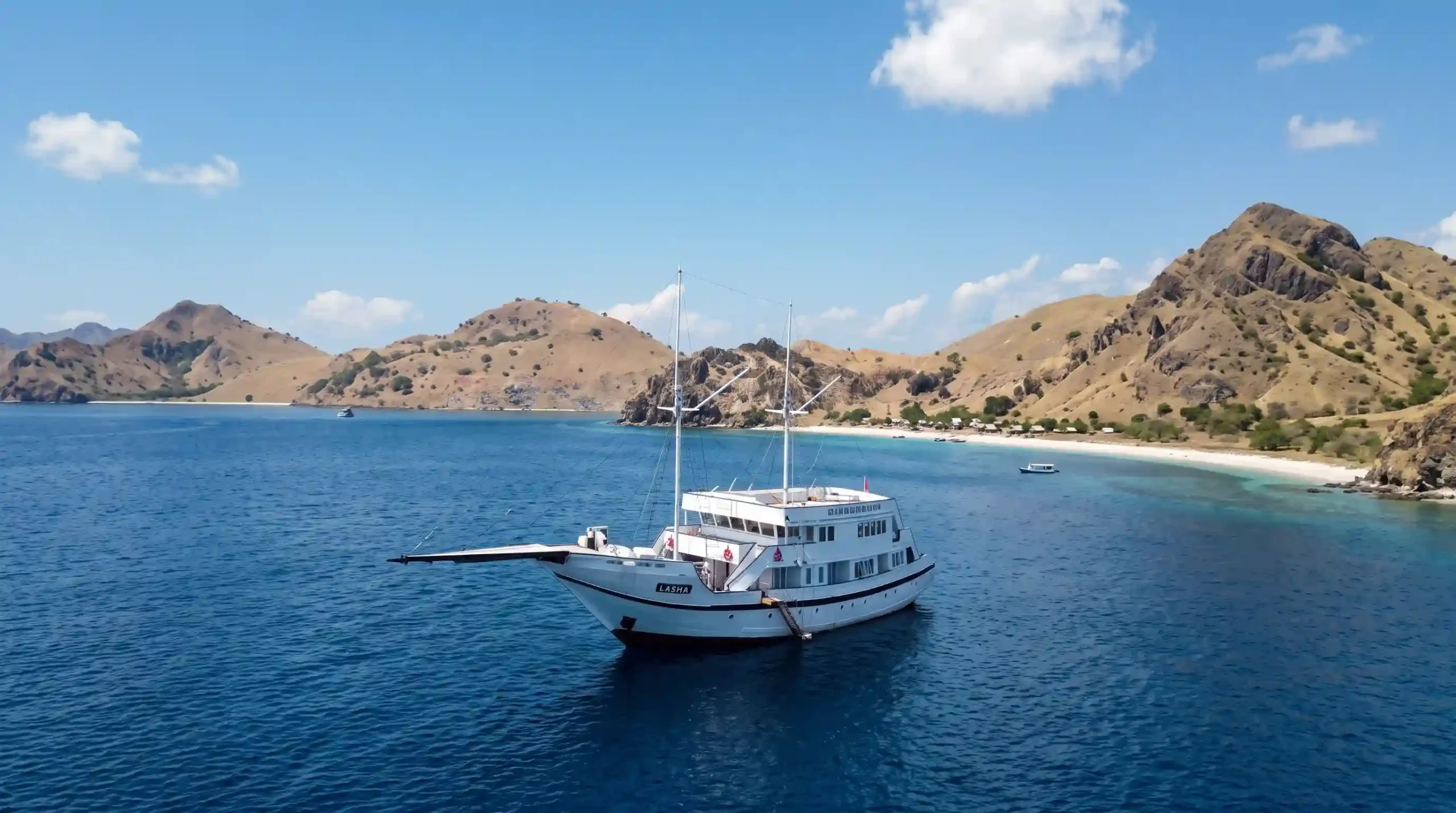

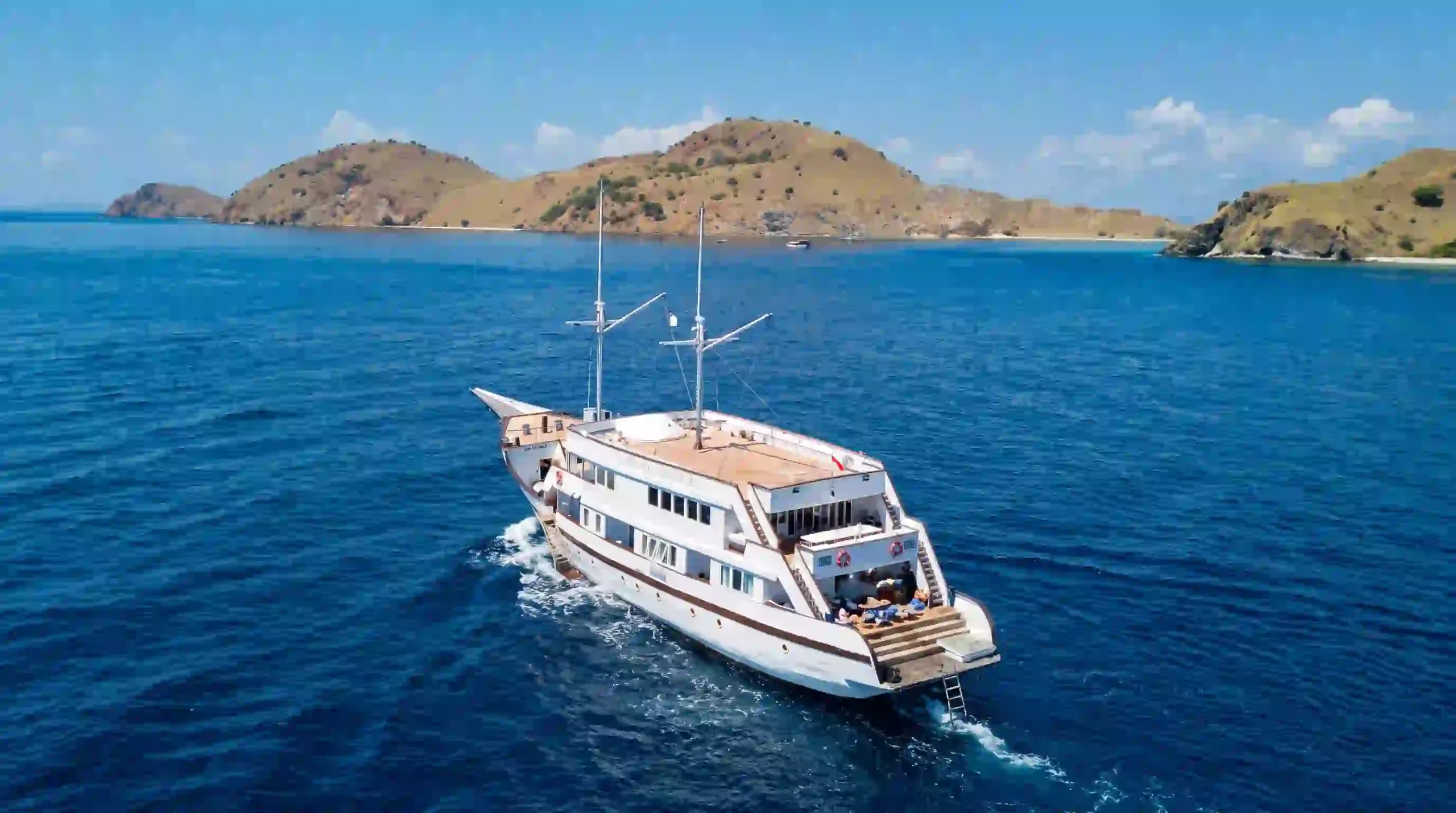
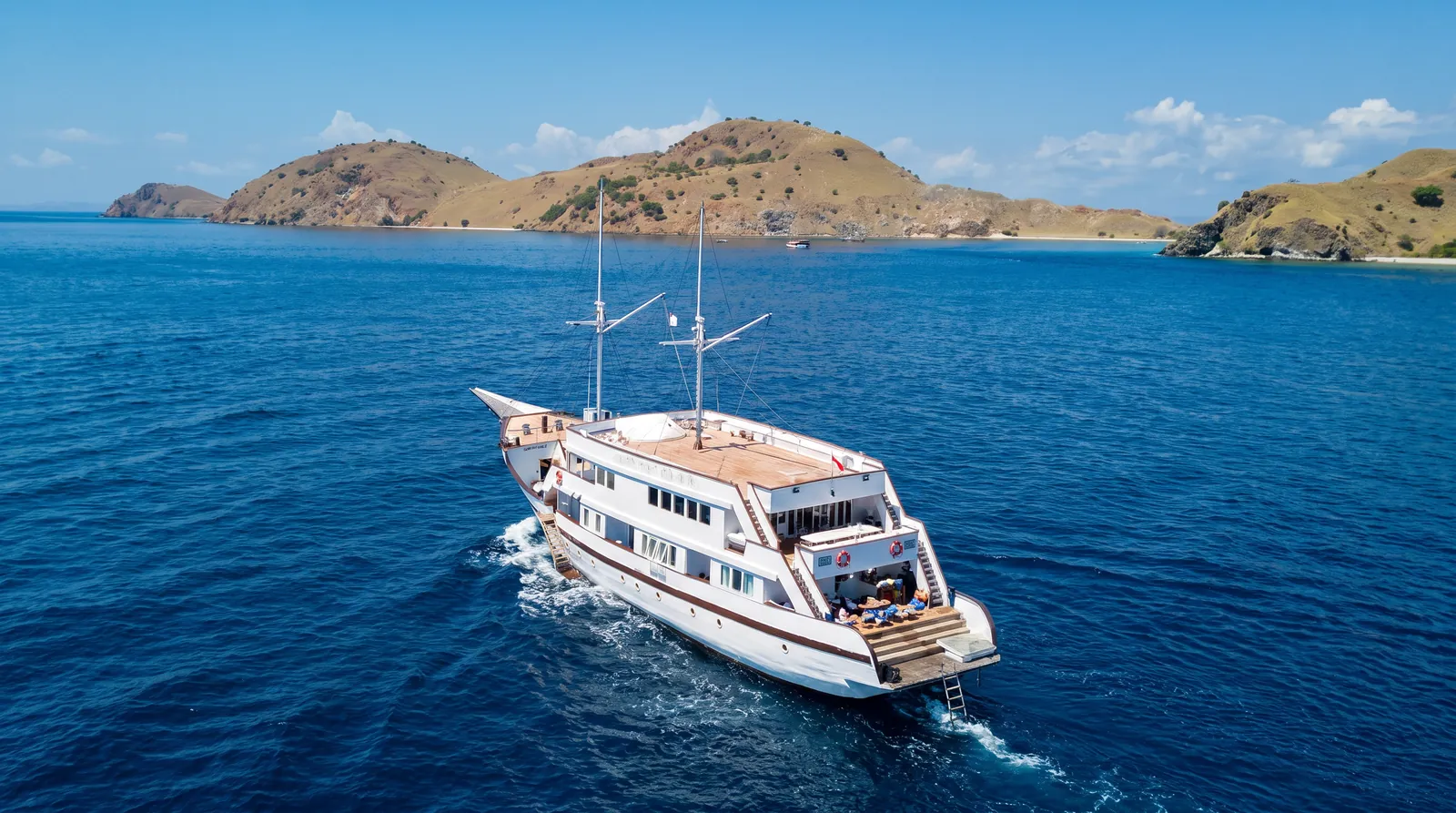
Yes — a well-run Komodo liveaboard is a safe way to explore the national park. LASHA is a 52.5-metre, 466 GT ironwood phinisi carrying a maximum of 26 guests, with life jackets for everyone on board, crew-assisted tender landings, sheltered night anchorages, and a captain who holds final authority over every weather decision.
Safety is the first question most guests ask before booking a Komodo liveaboard — ahead of cabins, menus, or even the dragons themselves. It deserves a straight answer rather than a brochure line. This guide explains how a modern phinisi is built and run: what keeps a large sailing yacht stable, what equipment is on board LASHA, why the park's waters are calmer than most first-time visitors expect, and exactly how the captain makes the call when the wind does pick up.
How stable is a 52.5-metre phinisi like LASHA?
Stability on a phinisi starts with mass. LASHA was built by Buginese shipwrights from ulin — Bornean ironwood, one of the densest boatbuilding timbers in the world — with teak throughout the interior, and completed in 2023. At 52.5 metres and 466 gross tonnes across four decks, she is a displacement hull: she sits deep in the water and moves through swell rather than bouncing over it. Guests who have only experienced small day boats in Komodo notice the difference immediately; at this tonnage, motion at anchor is a slow, gentle roll rather than a chop.
One point worth stating plainly: LASHA is a traditional wooden phinisi and does not carry active fin stabilizers. Her steadiness comes from weight, beam, and — most importantly — routing. Inside the park, itineraries run through channels and leeward bays where there is little swell to stabilize against in the first place. A 750 hp Weichai main engine gives her the power to hold course through Komodo's famous tidal currents and to time channel transits precisely.
What safety equipment and procedures does LASHA carry?
The equipment list matters less than the habits around it. On embarkation day in Labuan Bajo, the crew runs a safety briefing covering life jackets, muster points, and how tender landings work. From there, the routines are consistent:
- Life jackets are provided for every guest and crew member and are worn on every tender transfer as standard practice, not on request.
- Tender protocol: guests never swim ashore. Crewed tenders handle every beach and jetty landing, and a tender shadows snorkel and dive groups on the surface throughout dive and snorkel sessions.
- A dedicated dive deck keeps tanks, gear, and water entry points separate from guest lounging areas — exactly the separation smaller boats cannot offer.
- Modern navigation and communications keep the bridge in contact with Labuan Bajo, the park's ranger posts, and nearby vessels. Komodo cruising happens inside a busy, monitored marine park, not on open ocean.
| Safety factor | How LASHA handles it |
|---|---|
| Hull & stability | 466 GT ironwood displacement hull (2023); mass, beam and routing — no active fin stabilizers |
| Life jackets | For all guests and crew; worn on every tender transfer |
| Landings | Crew-assisted tender landings; tenders shadow snorkel and dive groups |
| Night hours | At anchor in sheltered bays — night sailing inside the park is restricted |
| Weather calls | Captain holds final authority; itineraries reorder around wind and current |
| Capacity | Maximum 26 guests in 10 ensuite cabins across four decks |
Why are the waters inside Komodo National Park relatively calm?
Geography does a great deal of the work. Komodo National Park is an archipelago — Komodo, Rinca, Padar, and dozens of smaller islands — and almost all cruising happens in the channels and bays between them, in the lee of high volcanic terrain. Long-period ocean swell breaks up well before it reaches the anchorages guests actually visit.
In the dry season, roughly April through November, the southeast trade winds are steady and predictable: calm mornings, a breeze building through the afternoon, settled nights. Captains plan crossings and exposed passages for early in the day and keep afternoons in protected water. The crossings themselves are short — Labuan Bajo to the heart of the park is a matter of hours, not days — which is why Komodo is widely considered one of the most forgiving liveaboard destinations anywhere. The wetter months from roughly December to March bring more variable wind, and that is when a captain's judgement, and a flexible itinerary, matter most.
Where does LASHA spend the night — and is night sailing allowed?
Komodo National Park restricts night navigation for vessels operating inside its boundaries, and the practical effect is one of the park's best safety features. By evening, LASHA is at anchor in a sheltered, leeward bay with good holding — nights on board are typically the calmest hours of the entire trip. We cover the rule in detail in our guide to whether night sailing is allowed in Komodo National Park.
The restriction also shapes the rhythm of a charter in your favour. Anchorages are chosen close to the next morning's sites, so you wake at sunrise already positioned — often with Padar's ridgeline or a pink beach a short tender ride away, before the day boats arrive from Labuan Bajo.
When does the captain postpone or reroute for weather?
On every LASHA departure, the sailing plan belongs to the captain, not to the brochure — and that is the single most important safety system on board. In practice, weather decisions in Komodo look like this:
- Reordering the day — visiting a leeward site in the morning and saving the exposed one for settled conditions, with no time lost.
- Timing the channels — Komodo's currents run on the tide, so transits are scheduled for slack water rather than fought head-on.
- Substituting sites — if a northern bay is windy, an equivalent southern one usually is not; the park's geography almost always offers a protected alternative.
- Postponing a crossing — the rarest call, mostly relevant in the December–March season. A delayed departure from Labuan Bajo is not a failed trip; it is the system working exactly as designed.
Guests on a private charter feel this flexibility most: with the whole boat, the captain can rebuild the route around conditions without negotiating between separate groups.
Do you need travel insurance for a Komodo liveaboard?
Strongly recommended — not because incidents are common, but because weather flexibility works best when your travel arrangements can flex with it. A good policy for a Komodo liveaboard covers three things: trip delay and interruption, so a postponed crossing or a missed connection in Labuan Bajo is an inconvenience rather than a loss; overseas medical treatment and evacuation; and, if you plan to dive, a dive-specific rider or a dedicated dive policy such as DAN. Book flights with reasonable buffers on either side of your charter dates, and share your insurance details with the reservations team before departure.
How to book a Komodo charter with confidence
LASHA is operated by Komodo Luxury (PT Komodo Bahari Nusantara), a Labuan Bajo operator established in 2015 — the captain and crew sail these waters year-round, and her maiden voyage on 17 August 2026 makes her one of the newest hulls in the park. Whole-boat charters are priced by trip length and group size, minimum two nights; full pricing, including diving charters and larger groups, is on the rates page. Booking directly also means weather decisions reach you early, from the people actually making them.
⚓ This guide is part of the journal of the LASHA yacht — the 52.5-metre luxury phinisi sailing Komodo National Park and Raja Ampat. Official booking only via lashacruise.com · WhatsApp +62 811-3823-875 (Komodo Luxury).