
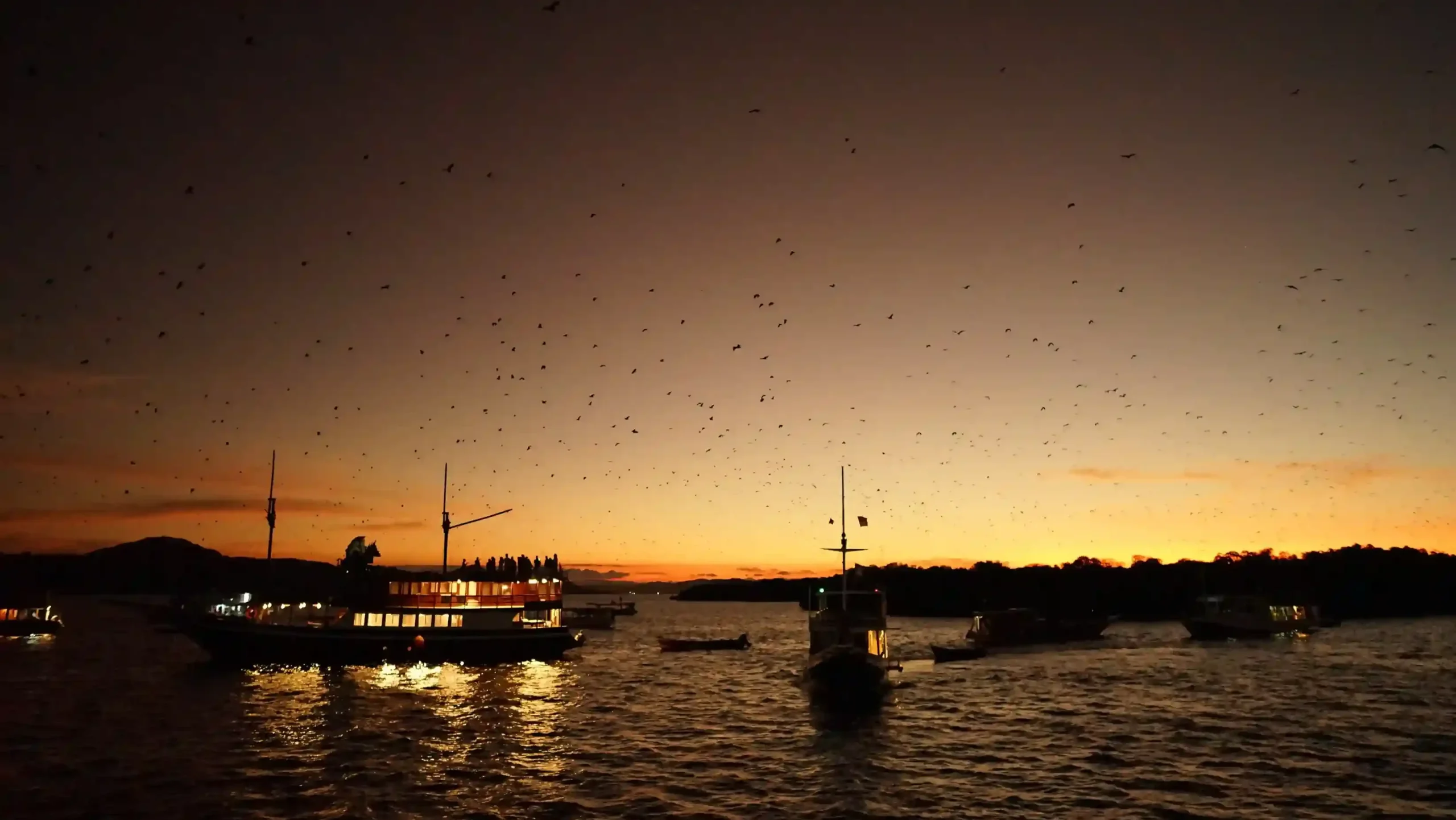
No. Since early 2026 the harbour authority in Labuan Bajo, KSOP Class III, has barred tourist vessels from moving at night across a list of waters identified as dangerous in and around Komodo National Park. Boats are expected to be anchored or sheltered overnight. No official start and end time has been published.
Is night sailing allowed in Komodo National Park?
Not for tourist vessels. The restriction was announced by the head of the Class III Port Authority and Harbourmaster Office (KSOP) in Labuan Bajo, Stephanus Risdiyanto, and was reported on 9 January 2026 alongside the resumption of cruising after a run of weather closures. It was restated when cruising reopened again in February 2026. This is a safety measure administered by the maritime authority, not by the national park.
That distinction matters more than it sounds. Two different bodies govern a Komodo cruise. Balai Taman Nasional Komodo controls conservation matters — tickets, entry windows, what you may do ashore and in the water. KSOP controls whether a vessel may sail at all, through the sailing approval (Surat Persetujuan Berlayar) and the passenger manifest that accompanies it. A boat can hold valid park tickets and still not be permitted to move.
Which waters does the restriction cover?
Reporting of the February 2026 restatement listed ten stretches of water identified as hazardous:
- Kelor Island waters
- Batu Tiga
- Molo Strait
- Padar Strait
- Loh Kima
- Luwu Island
- Kerangga Island
- Mauwang Island
- Tatawa Island
- Siaba Island
The stated reasons are strong currents, high swell, dangerous winds, whirlpools and exposed reef formations. Anyone who has watched the tide run through the Molo or Padar straits will recognise the logic: these are narrow, current-driven channels where a wooden hull under way in darkness has very little margin.
What hours does the ban actually cover?
Here we decline to give a tidy answer, because no tidy answer has been published. The official wording reported in every account is simply that movement at night is prohibited. We have found no published circular or notice assigning the restriction a specific clock window, and no document number issued specifically for the night rule. A shipping notice dated 12 January 2026 that circulated at the time concerned the weather-driven suspension of sailing approvals, which is a separate matter.
So if you read a guide that states the ban confidently as a fixed clock window — sunset to sunrise, or any pair of exact hours — that window was invented somewhere along the chain. The operational answer is that the captain clears his movements with KSOP, and the times that matter are the ones KSOP gives him on the day.
Where does a boat anchor overnight?
The park's own visitor protocol places a hard constraint on this. It prohibits dropping anchor in water shallower than 30 metres except on ground that is entirely sand. The rule exists to protect coral, and it narrows the choice of overnight positions considerably — a bay that looks perfectly sheltered on a chart may be unusable because of what is on the bottom.
No official list of named safe anchorages or their coordinates has been published, so we will not print one. Anchorage selection is a matter for the captain, working from the vessel's own survey knowledge, the conditions on the night, and KSOP's direction.
How does this change a Komodo itinerary?
The practical effect is that distance has to be covered in daylight. Several consequences follow directly:
- No overnight repositioning. Itineraries that once quietly moved a long leg while guests slept now have to sail that leg in daylight, using hours the guest programme previously had.
- Early-morning sites require pre-positioning. A vessel has to be anchored within a short tender run of a site the evening before, rather than steaming towards it in the dark.
- Short formats feel it most. The tighter the programme, the more a daylight-only movement rule constrains it. A longer charter absorbs the constraint more comfortably.
- Tight onward connections become risky. A return flight booked hard against a disembarkation morning leaves no room for a night the fleet had to sit still.
Does weather close the park as well?
Yes, and separately. Sailing in the waters of West Manggarai was suspended repeatedly between late December 2025 and early February 2026 — reporting at the end of January counted eight successive closures. The park authority extended its own tourism closure to 1 February 2026, and cruising reopened on 4 February 2026. Reporting in early August 2026 described sailing to Padar and Komodo islands being suspended for several days during what is nominally the dry season, with Rinca continuing to operate.
The useful conclusion is not that a particular month is unsafe. It is that the calendar advice repeated across most Komodo content — April to October is the safe season — describes a weather pattern, not a guarantee. Closures are decided on conditions, and they have occurred inside the dry season. Sailing status can change at any time; verify with KSOP Labuan Bajo and your operator before departure rather than relying on any published seasonal rule, this page included.
What this means for your trip
Build the itinerary with slack in it, treat an early-morning landing as an intention rather than a promise, and leave a buffer day between disembarkation and an international flight. Ask any operator you are considering how they handle a suspension: whether they hold position, substitute a site that remains open, or extend. The answer tells you a great deal about how the vessel is run.
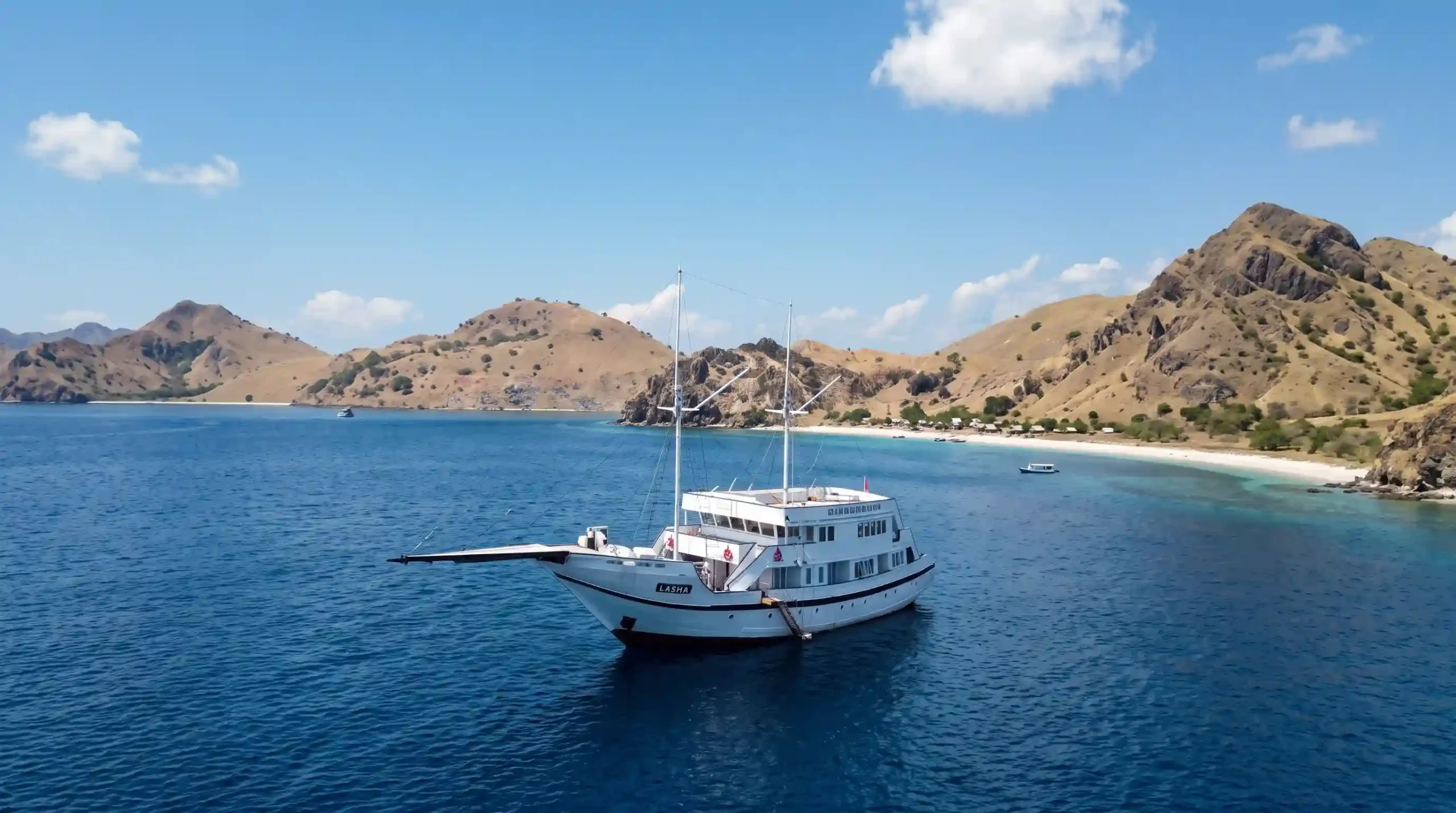
One more thing worth knowing about any wooden phinisi, including this one. LASHA is a wooden-hulled vessel with no active fin stabilisers — the site says so plainly rather than leaving it to be discovered at sea. On a Komodo programme, where movement is now confined to daylight and sheltered nights are the norm, that matters less than it would on an open-water crossing. It is still the kind of detail worth asking every operator about before you book.
LASHA is home-ported in Labuan Bajo and chartered as a whole boat only. Bookings and questions: Komodo Luxury, WhatsApp +62 811 3823 875 · [email protected].
Frequently Asked Questions
Can a liveaboard sail between Komodo islands at night in 2026?
Tourist vessel movement at night has been restricted by KSOP Class III Labuan Bajo since early 2026 across ten stretches of water identified as dangerous, including the Molo and Padar straits. Vessels are expected to anchor or shelter overnight rather than transit.
What time does the Komodo night sailing ban start and end?
No official start and end time has been published. The wording used by the authority is simply that sailing at night is prohibited. Any guide quoting a fixed clock window is not reflecting a published rule, and in practice the captain confirms his movements with KSOP directly.
Can a boat anchor anywhere in Komodo National Park overnight?
No. The park's visitor protocol prohibits anchoring in water shallower than 30 metres unless the seabed is entirely sand, in order to protect coral. No official list of named safe anchorages has been published, so overnight positions are chosen by the captain according to conditions and KSOP direction.
Planning your own charter? Start with the published LASHA rates 2026–2027, see life on board in the LASHA liveaboard guide, or go straight to the official booking page.
⚓ This guide is part of the journal of the LASHA Liveaboard — the 52.5-metre luxury phinisi sailing Komodo National Park and Raja Ampat. Official booking only via lashacruise.com · WhatsApp +62 811-3823-875 (Komodo Luxury).
Can a liveaboard sail between Komodo islands at night in 2026?
Tourist vessel movement at night has been restricted by KSOP Class III Labuan Bajo since early 2026 across ten stretches of water identified as dangerous, including the Molo and Padar straits. Vessels are expected to anchor or shelter overnight rather than transit.
What time does the Komodo night sailing ban start and end?
No official start and end time has been published. The wording used by the authority is simply that sailing at night is prohibited. Any guide quoting a fixed clock window is not reflecting a published rule, and in practice the captain confirms his movements with KSOP directly.
Can a boat anchor anywhere in Komodo National Park overnight?
No. The park's visitor protocol prohibits anchoring in water shallower than 30 metres unless the seabed is entirely sand, in order to protect coral. No official list of named safe anchorages has been published, so overnight positions are chosen by the captain according to conditions and KSOP direction.
Planning your own charter? Start with the published LASHA rates 2026–2027, see life on board in the LASHA liveaboard guide, or go straight to the official booking page.
⚓ This guide is part of the journal of the LASHA Liveaboard — the 52.5-metre luxury phinisi sailing Komodo National Park and Raja Ampat. Official booking only via lashacruise.com · WhatsApp +62 811-3823-875 (Komodo Luxury).