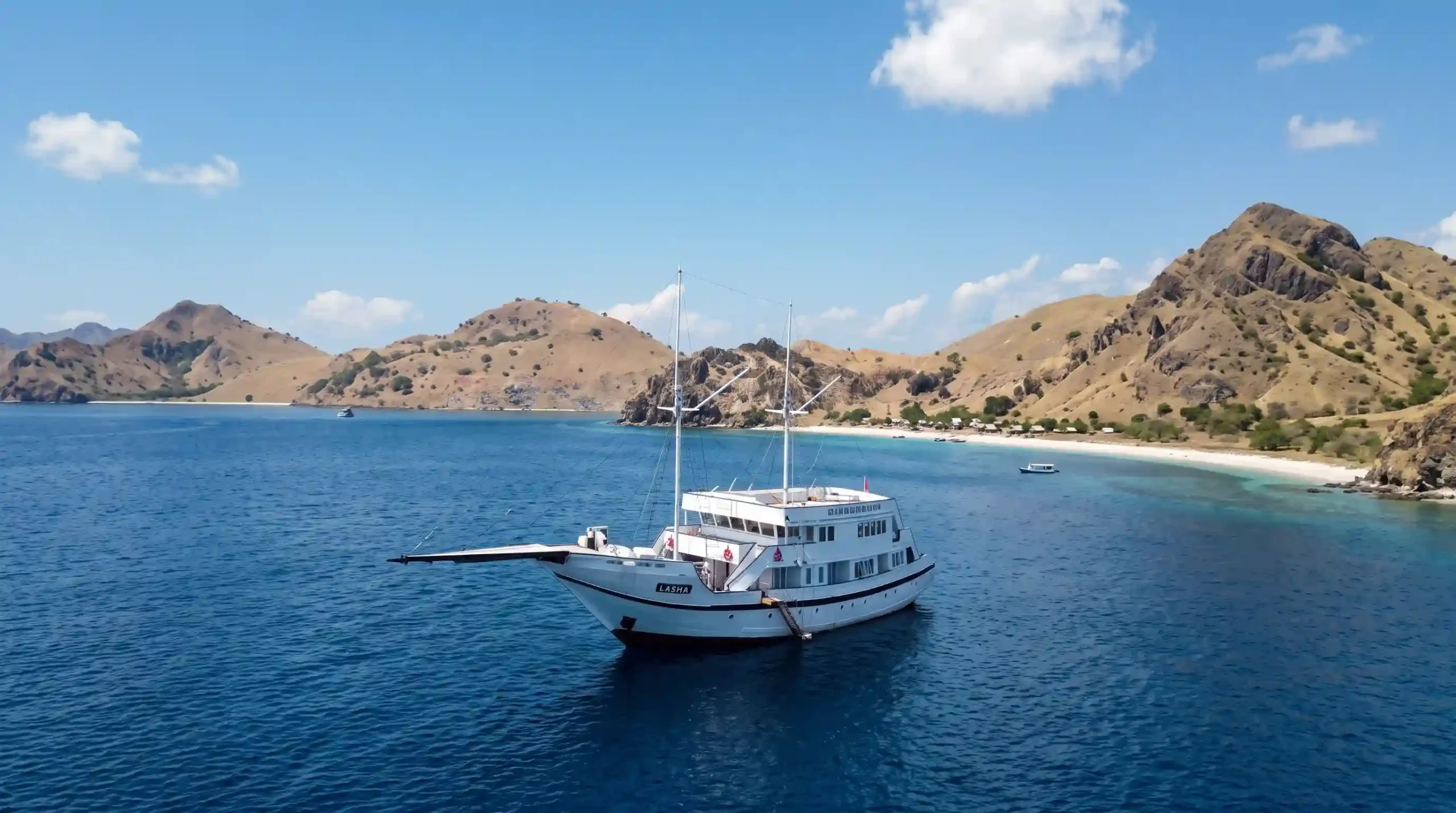

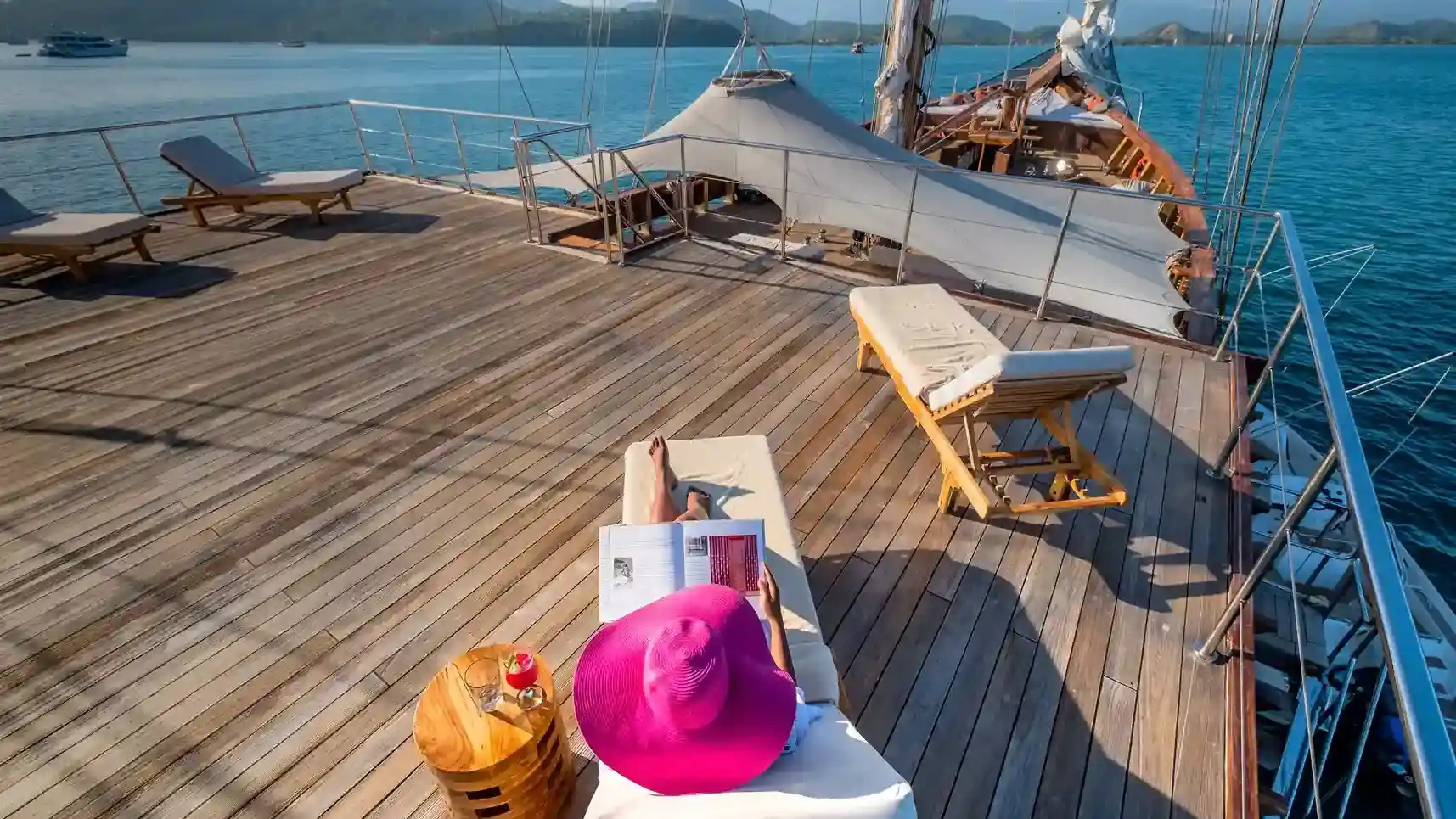
Steel usually wins on range and stabilisation; a large phinisi wins on deck space, cost and comfort at anchor. For Indonesian crossings sailed inside their proper weather windows, either type is appropriate — what actually matters is size, certification and safety equipment. LASHA is 52.5 m, 10.3 m beam, 466 GT, built 2023 in ironwood and teak, with two lifeboats, four 20-person liferafts, EPIRB, AIS, radar and SART.
Divers comparing long-range Indonesian boats usually end up on this question, and it is usually answered badly in both directions — either "wooden boats are traditional and romantic" or "steel is serious and wood is not". Neither is a specification. Here is what genuinely differs, what does not, and which questions are worth asking any operator.
What Actually Differs Between the Two Types?
| Factor | Large wooden phinisi | Steel motor vessel |
|---|---|---|
| Motion at sea | Rolls more without stabilisers; length and beam are the main damping | Often stabilised; generally steadier in a swell |
| Deck space per guest | Substantially more — multiple open decks are intrinsic to the type | Usually more enclosed, less open deck per guest |
| Range | Set by tankage and bunkering plan | Typically greater fuel capacity and range |
| Build and maintenance | Ironwood and teak, built and maintained locally by specialist yards | Steel: corrosion management, dry-docking, specialist yards |
| Cost to charter | Generally lower for equivalent guest capacity | Generally higher |
| Comfort at anchor | Excellent — the type is designed for tropical anchorage living | Good, but usually less open deck |
| Safety equipment | Determined by certification, not hull material | Determined by certification, not hull material |
This is a comparison of vessel types in general. Any specific vessel should be judged on its own certification and equipment list.
Does Wood Mean Less Safe?
No — and the way to establish that is to ask for the equipment list rather than to argue about material. LASHA carries two lifeboats, four twenty-person liferafts giving eighty places against a maximum of twenty-six guests, 75 life jackets, 30 fire extinguishers and 12 ring buoys, with an EPIRB, Samyung AIS, radar with SART, Garmin GPS, iCom communications and a 54-channel CCTV installation. She is Indonesian flagged, 466 GT, built in 2023. Those are the numbers that answer the safety question. Ask any operator for the equivalent list; a vessel that cannot produce one is telling you something.
What About Range on a Long Crossing?
This is where honesty costs a marketing sentence. LASHA carries 12,000 litres of fuel and 22,000 litres of fresh water. Turning that into a headline range figure would require a consumption number that is not published, so we do not publish a range. Instead, crossings are planned around a working speed of eight to ten knots — which is how 800 to 1,000 nautical miles between Labuan Bajo and Sorong becomes five to seven days of pure transit — with bunkering scheduled into the route. If another operator quotes you a precise range, ask what consumption assumption it is based on.
Which Type Suits Which Trip?
- Crossings inside the weather windows — March to April and September to November in the Banda Sea — suit both types. Outside those windows, neither should be out there.
- Long anchorage-based itineraries in Raja Ampat favour the phinisi: you spend far more hours at anchor than under way, and deck space is what you live on.
- Guests badly affected by motion should ask specifically about stabilisation rather than about hull material, and should consider northern archipelago routes that avoid open-water days.
- Large groups favour the phinisi on economics — 26 berths across four decks at a band starting from $11,600 per night.
The complete specification, deck by deck and cabin by cabin, is on the vessel page, and what a long itinerary demands of guests and crew alike is set out on the ten to fourteen day requirements page. For the motion question in plain terms, see our honest answer on seasickness.
Frequently Asked Questions
Is a phinisi or a steel motor vessel better for long crossings?
Steel vessels generally carry more fuel, more range and more often have stabilisers. A large phinisi carries far more usable deck space per guest and a different quality of comfort at anchor. For crossings inside the proper weather windows, either works; outside them, neither should be sailing.
Does a wooden hull handle open water safely?
A properly built and certified one does — LASHA is 466 GT, built in 2023 from ironwood and teak, Indonesian flagged, carrying two lifeboats, four twenty-person liferafts, 75 life jackets, EPIRB, AIS, radar and SART. The relevant question is certification and equipment, not hull material.
Does a phinisi roll more than a steel vessel?
Often, yes, particularly against a stabilised steel hull. Length and beam matter more than material — at 52.5 metres by 10.3 metres LASHA is a far steadier platform than a small phinisi — but no wooden phinisi is a stabilised motor yacht and we do not claim otherwise.
What is the range of a vessel like this?
LASHA carries 12,000 litres of fuel and 22,000 litres of fresh water. Actual range depends on consumption, which is not a published figure, so routes are planned around a working speed of eight to ten knots and scheduled bunkering rather than a headline range number.
Why are so many Indonesian expedition boats phinisi?
Because the type is built locally by boatbuilding communities with generations of experience, in ironwood and teak, at a cost and on a timescale that imported steel construction cannot match. The deck layout that results also happens to suit tropical cruising extremely well.
Which is better for divers specifically?
Deck space and tender handling decide this, not hull material. What matters is a dedicated dive deck, compressor capacity, tender numbers and a crew that runs a proper dive operation — ask about those rather than about steel versus wood.
Where These Numbers Come From
Vessel dimensions, tank capacities, cabin counts and safety inventory come from LASHA's own published specification sheet on the yacht page. Charter figures are the published 2026–2027 rate file on the rates page — the same document the Komodo Luxury charter desk quotes from, reproduced in full rather than hidden behind an enquiry form. Government fees are cited to their regulation or issuing body in the text. Anything that is an operational estimate rather than a published figure is labelled as an estimate where it appears. LASHA begins her maiden public season on 17 August 2026, so there are no guest reviews to quote yet and none are invented here. Comparisons between vessel types are general industry characteristics; only the LASHA figures are vessel-specific and those come from the published specification. Figures checked 1 August 2026.
Plan This With the Charter Desk
Ask for the safety and equipment list before you compare any two boats — it is the fastest way to tell a serious operation from a brochure. Every LASHA Phinisi Cruise booking is handled by Komodo Luxury, the vessel's official marketing and booking partner — an operator working Indonesian waters since 2015 and part of Juara Holding Group. Send your month, guest count and how many of the party dive, and you get a written quotation drawn from the same rate bands published on this site, with every separately billed item listed before anything is paid.
WhatsApp +62 811 3823 875 [email protected]
⚓ This guide is part of the journal of the LASHA boat in Komodo — the 52.5-metre luxury phinisi sailing Komodo National Park and Raja Ampat. Official booking only via lashacruise.com · WhatsApp +62 811-3823-875 (Komodo Luxury).