
Raja Ampat wins on coral diversity; Komodo wins on current, biomass and cost. Raja Ampat records over 540 hard coral species and around 1,300 reef fish in warm, stable water. Komodo offers stronger current, colder southern upwelling at 21–25 °C from June to September, and world-class pelagic sites — with Komodo's charter band priced by trip length on the rates page against Raja Ampat's $11,600 per night, a two-night minimum against five, and IDR 250,000 entry against IDR 1,700,000.
This is the comparison the charter desk is asked to make more than any other, usually by divers with one trip to spend and no appetite for marketing. Both destinations sit inside the Coral Triangle and both are genuinely world class, so the honest answer is not "one is better" — it is that they are good at different things and cost very different amounts to reach.
How Do They Compare Line by Line?
| Komodo | Raja Ampat | |
|---|---|---|
| Hard coral species | More than 250 | More than 540 — around 75% of known species |
| Reef fish species | More than 1,000 | Around 1,300 |
| Signature experience | Current diving, shark and pelagic biomass, manta aggregations | Coral density, soft coral colour, macro and reef fish variety |
| Current | Very strong at Castle Rock, Shotgun, Tatawa Kecil — reef hooks standard | Strong in the Dampier Strait, gentler across much of the archipelago |
| Water temperature | 26–29 °C north; 21–25 °C southern upwelling June–September | Warm and stable year round |
| Visibility | 15–30 m north; 10–20 m south | Typically 10–30 m, plankton-dependent |
| Access | Labuan Bajo — about 1–1.5 hours from Bali | Sorong — about 4–4.5 hours from Jakarta, 3–3.5 from Makassar |
| Park entry, foreign | IDR 250,000 per visit (PP 36/2024) | IDR 1,700,000 (conservation card plus regency levy) |
| Charter band, 1–14 pax | See rates page | $11,600 leisure · $12,400 diving |
| Minimum nights | 2 | 5 |
Charter figures are LASHA's published bands; dive-site conditions are drawn from operator and dive-centre reporting across both regions.
What Does Komodo Do Better?
Water movement, and everything that follows from it. Castle Rock and Crystal Rock run currents at the top of the scale with negative entries, and the payoff is grey reef and whitetip sharks, giant trevally, dogtooth tuna and barracuda stacked in the flow. Karang Makassar — Manta Point — is a gentle drift where mantas appear year round and beginners can dive it. Batu Bolong carries some of the densest fish biomass in Indonesia on a pinnacle you can circle in one dive. Add the cold southern sites at Manta Alley, where upwelling drops water to 21–25 °C and manta density peaks, and Komodo produces more dramatic diving per day than almost anywhere.
It is also simply easier to reach. Labuan Bajo is an hour to an hour and a half from Bali; Sorong is a four-hour domestic flight from Jakarta with an onward transfer beyond that.
What Does Raja Ampat Do Better?
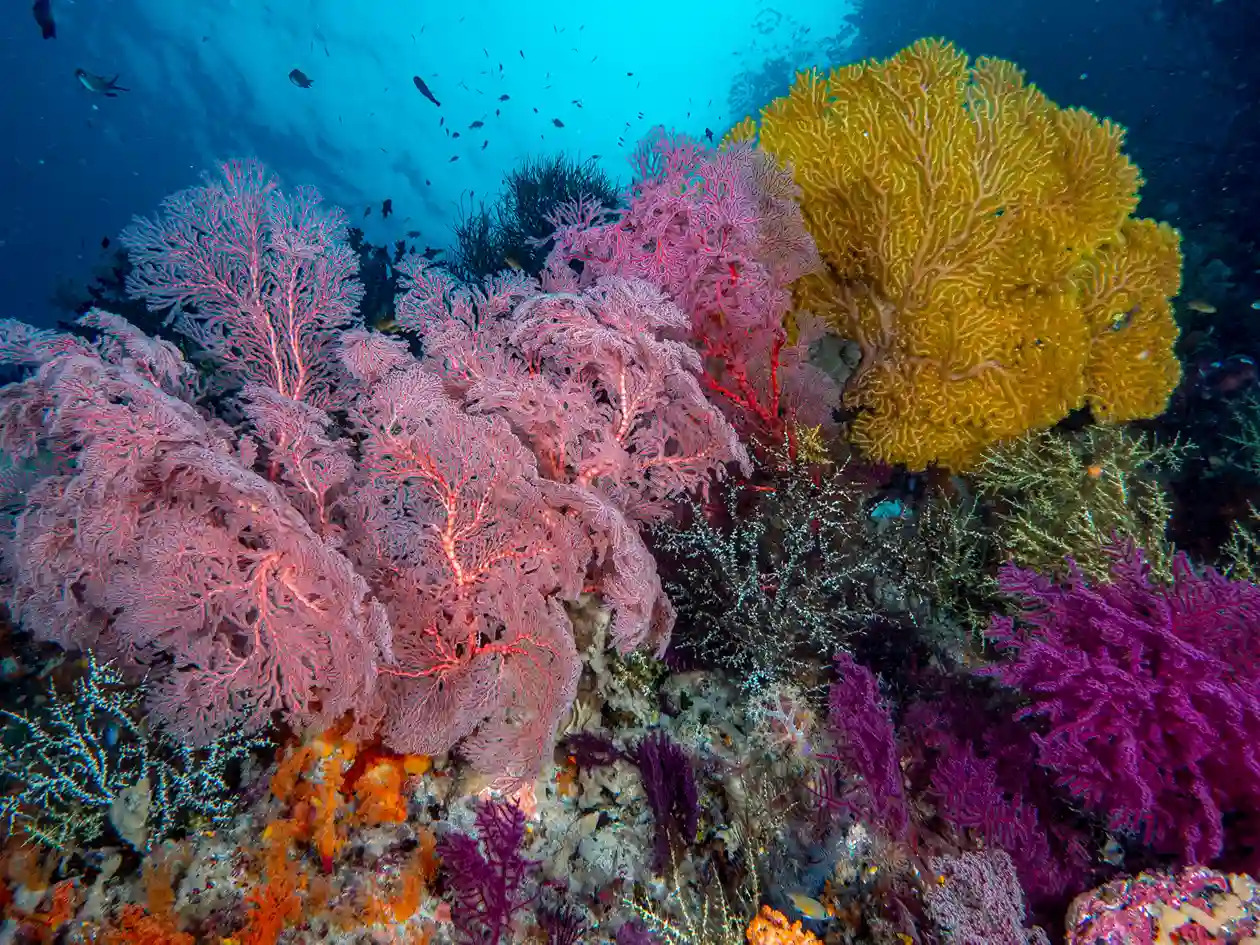
Coral. Not marginally — structurally. Over 540 hard coral species against Komodo's 250-plus means more distinct habitat types packed into a smaller distance, and the soft coral walls of southern Misool are the clearest expression of it. The water is warm and stable, so there is no thermocline planning and no 5 mm suit for the cold sites. And in the no-take reserve around Misool, where the Misool Foundation reports roughly 1,220 square kilometres closed to fishing, the fish density is what a reef looks like when it has been left alone for over a decade.
Which One Should You Book?
| If you are… | Go to | Why |
|---|---|---|
| Diving Indonesia for the first time | Komodo | Cheaper, closer, two-night minimum, and spectacular |
| Chasing sharks and current | Komodo | Castle Rock, Shotgun, Crystal Rock |
| A coral or macro photographer | Raja Ampat | Species density and soft coral colour |
| Short on time | Komodo | Two-night minimum against five, and a one-hour flight |
| Wanting the reef at its most protected | Raja Ampat — Misool | A no-take reserve with more than a decade of enforcement |
| Able to give it two weeks | Both, via the crossing | 800–1,000 nautical miles, 10–14 days, two windows a year |
No option here is wrong; they are priced and paced differently.
The crossing that joins them — route, distances, sea days and the full cost picture — is on the Komodo to Raja Ampat crossing page, and the Banda Sea leg in the middle, with its volcanoes and its honest hammerhead odds, is on the Banda Sea crossing page. If Raja Ampat wins on the diving but you are weighing a boat against a resort, we compared those directly in liveaboard versus resort.
Frequently Asked Questions
Komodo or Raja Ampat — which is better for diving?
Raja Ampat for coral diversity and colour; Komodo for current, biomass and pelagic encounters. If you want soft coral walls and 540-plus coral species, go east. If you want reef hooks, sharks stacked in current and manta cleaning stations, Komodo delivers more per day and costs far less to reach.
Which is harder diving?
Komodo, without much argument. Sites like Castle Rock and Shotgun run currents rated at the top of the scale with negative entries and reef hooks as standard. Raja Ampat has serious current in the Dampier Strait, but a larger share of its best diving is accessible to moderately experienced divers.
Which is colder?
Komodo's south, decisively. Upwelling from the Indian Ocean pushes water to 21–25 °C from June to September with sharp thermoclines, while the north sits at 26–29 °C. Raja Ampat is warm and stable year round.
Which is cheaper?
Komodo, on every line. Komodo's charter band is priced by trip length — see the rates page — and runs well below the $11,600 eastern band; the minimum is two nights against five, and park entry is IDR 250,000 against IDR 1,700,000.
Can I do both in one trip?
Yes, and that is precisely what the crossing is: 800 to 1,000 nautical miles between the two, on itineraries of ten to fourteen days, in the March–April or September–November windows.
Which should a first-time Indonesia diver choose?
Komodo, for most people. It is cheaper, closer, shorter to commit to and extraordinarily good. Raja Ampat rewards the diver who already knows they want coral diversity above everything else.
Where These Numbers Come From
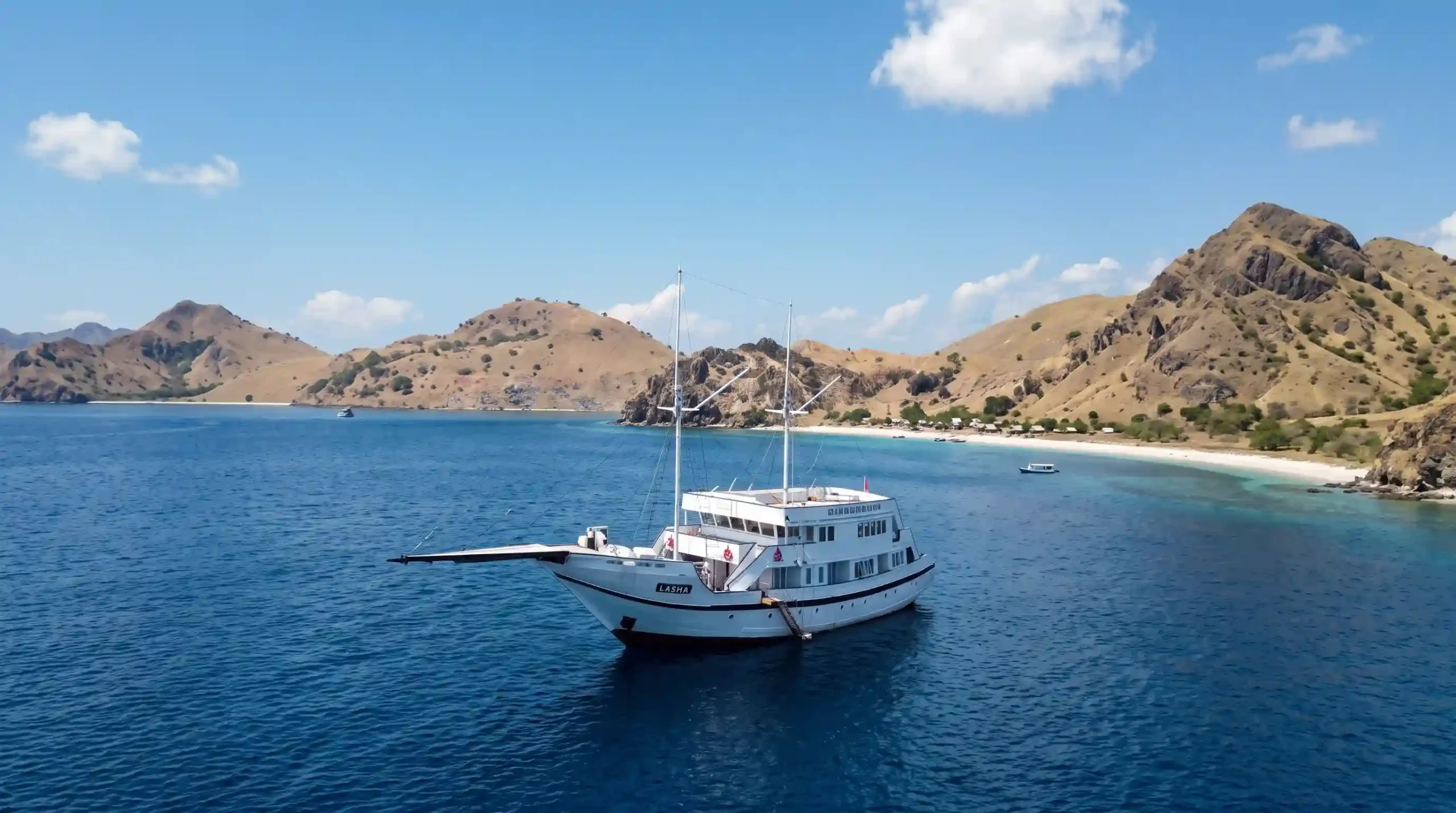
Vessel dimensions, tank capacities, cabin counts and safety inventory come from LASHA's own published specification sheet on the yacht page. Charter figures are the published 2026–2027 rate file on the rates page — the same document the Komodo Luxury charter desk quotes from, reproduced in full rather than hidden behind an enquiry form. Government fees are cited to their regulation or issuing body in the text. Anything that is an operational estimate rather than a published figure is labelled as an estimate where it appears. LASHA begins her maiden public season on 17 August 2026, so there are no guest reviews to quote yet and none are invented here. Dive-site conditions, depths, currents and temperature ranges are compiled from dive-centre and operator reporting across both regions and are presented as typical conditions rather than guarantees. Figures checked 1 August 2026.
Plan This With the Charter Desk
Tell the desk which of the two lists above sounds like your group and you will get an honest steer, including "go to Komodo instead" where that is the right answer. Every LASHA Phinisi Cruise booking is handled by Komodo Luxury, the vessel's official marketing and booking partner — an operator working Indonesian waters since 2015 and part of Juara Holding Group. Send your month, guest count and how many of the party dive, and you get a written quotation drawn from the same rate bands published on this site, with every separately billed item listed before anything is paid.
WhatsApp +62 811 3823 875 [email protected]
⚓ This guide is part of the journal of LASHA Cruise — official site — the 52.5-metre luxury phinisi sailing Komodo National Park and Raja Ampat. Official booking only via lashacruise.com · WhatsApp +62 811-3823-875 (Komodo Luxury).