
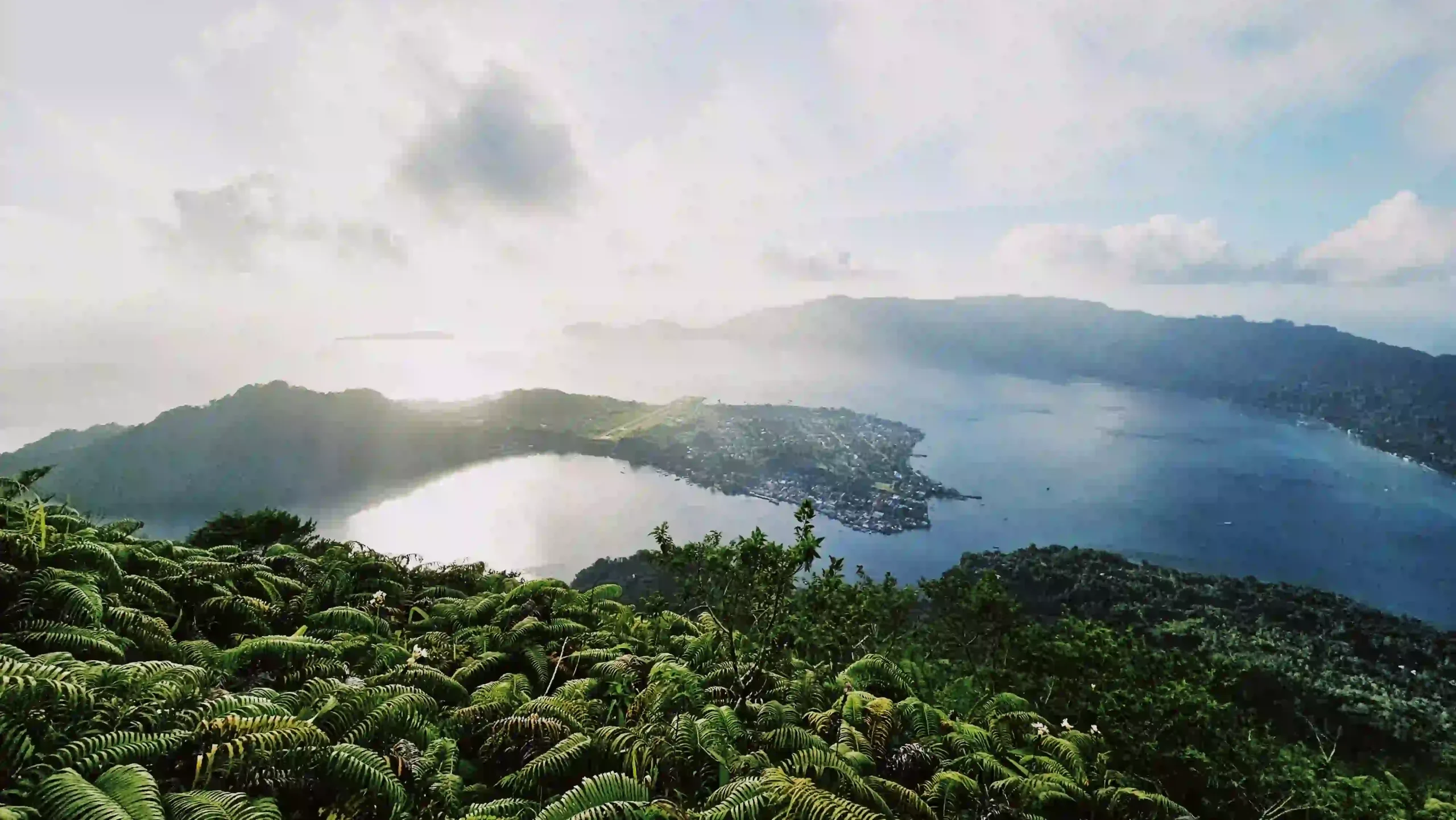
Banda Neira is the old capital of the nutmeg trade and the most historically dense landfall on any Indonesian expedition route. Ashore you get Fort Belgica, built by the Dutch in 1611, the ruins of Fort Nassau from 1609, colonial perkenier houses and working nutmeg groves. Under water you get the reef that regrew over Gunung Api's 1988 lava flow. Expedition boats reach it in the March–April and September–November windows only.
Most people who sail the Banda Sea come for the water. Then they go ashore at Banda Neira and spend the evening reading about the seventeenth century. It is a small town on a small island in one of the remotest corners of Indonesia, and for roughly two hundred years it was the commercial centre of a global commodity that Europe went to war over. Here is what is actually there, and why the stop earns its place on a twelve-night itinerary.
Why Did a Village This Small Matter So Much?
Nutmeg and mace — two spices from the same fruit — grew commercially nowhere else on earth. The Banda Islands held a genuine natural monopoly on a product that European markets valued extravagantly, and the Dutch East India Company set out to control it absolutely. What followed in 1621 under Jan Pieterszoon Coen was one of the most brutal episodes of the colonial period, and it emptied the islands of most of their original population. The plantation system that replaced it, run by licensed planters known as perkeniers, shaped the town you walk through today.
The most repeated Banda fact is also true: under the Treaty of Breda in 1667 the English gave up their claim to the tiny island of Run in exchange for Dutch recognition of English control of New Amsterdam — the island that became Manhattan. Standing on the seafront at Banda Neira and looking across at Run makes that trade feel considerably stranger than it does in a book.
What Is There to See Ashore?
| Site | What it is | Why it matters |
|---|---|---|
| Fort Belgica | Pentagonal Dutch fort above the town, built 1611 | Restored, walkable ramparts, the classic view over the bay to Gunung Api |
| Fort Nassau | Earlier Dutch fort of 1609, largely ruined | The older layer of the same story, quieter and rarely busy |
| Perkenier houses and the old town | Colonial-era streets and plantation-owner residences | The domestic architecture of the spice monopoly, still lived in |
| Nutmeg groves | Working plantations under kanari shade trees | The crop itself — fruit, mace and nut, still processed by hand |
| The waterfront | Village harbour beneath the volcano | Where the expedition tender lands and where the town gathers |
A day is enough for the town. Two days is enough to feel it.
What Is the Diving Like Around Banda?
Two very different things. Around the bay and the outer islands there is classic Banda reef diving — walls, healthy hard coral and the mandarinfish sites the islands are known for. Then there is the lava flow. When Gunung Api erupted in 1988 its flows ran into the sea on the island's northern side, sterilising the reef completely. What grew back is one of the most studied natural experiments in coral recovery anywhere, with dense hard-coral cover reported over the flow within roughly a decade. Diving it is genuinely strange: table corals stacked over black volcanic rock that is younger than most of the divers looking at it.
The Banda Sea's other draw — schooling hammerheads — is seasonal and site-specific rather than a Banda Neira attraction, and it is covered honestly, odds rather than promises, on the Banda Sea crossing page.
When Can You Actually Get There?
This is the constraint that decides everything. The Banda Sea has two workable weather windows for expedition traffic: March to April in the westerly transition, and September to November in the easterly. Operators avoid December to March and the strong months of June to September. That is why a Banda call cannot be added to a short itinerary on request — the islands sit in the middle of a crossing that only makes sense twice a year, on trips of ten nights and up. What that commitment involves in practice is set out in the expedition requirements page.
If the volcano itself is the draw rather than the town, the climb and the lava-flow reef get their own treatment in our guide to Gunung Api.
Frequently Asked Questions
Why were the Banda Islands so important historically?
Until the nineteenth century they were the only place on earth where nutmeg and mace grew commercially. That monopoly made a handful of small volcanic islands one of the most fought-over pieces of territory in the world, and it is why a Dutch fort sits above a village of a few thousand people.
Is it true Run island was traded for Manhattan?
In effect, yes. Under the Treaty of Breda in 1667 the English relinquished their claim to Run in the Banda group and the Dutch relinquished New Amsterdam, which became New York. It is the single most quoted fact about the islands, and unusually for travel trivia it is accurate.
What can you actually visit in Banda Neira?
Fort Belgica above the town, the ruins and grounds of Fort Nassau below it, the colonial streets and the old perkenier houses, and the nutmeg groves themselves. It is a walkable town, which is rare on an expedition itinerary.
How long do expedition boats stop at Banda Neira?
Typically a day: ashore in the morning while the light is good for the fort and the town, diving or snorkelling around the bay and Gunung Api's lava flow in the afternoon. Longer stops depend on the crossing schedule.
When can you visit Banda on a liveaboard?
In the two Banda Sea windows — roughly March to April and September to November. Outside those months operators avoid the crossing entirely, so the islands are effectively closed to expedition traffic for much of the year.
Is Banda Neira worth the sea days it costs?
For travellers who care about history as much as reefs, it is the strongest argument for taking the long route rather than flying. If your interest is purely underwater, the northern Raja Ampat sailings deliver more diving for fewer passage days.
Where These Numbers Come From
Vessel dimensions, tank capacities, cabin counts and safety inventory come from LASHA's own published specification sheet on the yacht page. Charter figures are the published 2026–2027 rate file on the rates page — the same document the Komodo Luxury charter desk quotes from, reproduced in full rather than hidden behind an enquiry form. Government fees are cited to their regulation or issuing body in the text. Anything that is an operational estimate rather than a published figure is labelled as an estimate where it appears. LASHA begins her maiden public season on 17 August 2026, so there are no guest reviews to quote yet and none are invented here. Historical material on the Banda Islands — the nutmeg monopoly, the 1621 events, the forts of 1609 and 1611 and the Treaty of Breda in 1667 — is established public history and is presented here without embellishment. Figures checked 1 August 2026.
Plan This With the Charter Desk
Banda calls sit inside the crossing itineraries only, so ask early which 2027 window suits your group. Every LASHA Phinisi Cruise booking is handled by Komodo Luxury, the vessel's official marketing and booking partner — an operator working Indonesian waters since 2015 and part of Juara Holding Group. Send your month, guest count and how many of the party dive, and you get a written quotation drawn from the same rate bands published on this site, with every separately billed item listed before anything is paid.
WhatsApp +62 811 3823 875 [email protected]
⚓ This guide is part of the journal of LASHA Cruise — official site — the 52.5-metre luxury phinisi sailing Komodo National Park and Raja Ampat. Official booking only via lashacruise.com · WhatsApp +62 811-3823-875 (Komodo Luxury).