

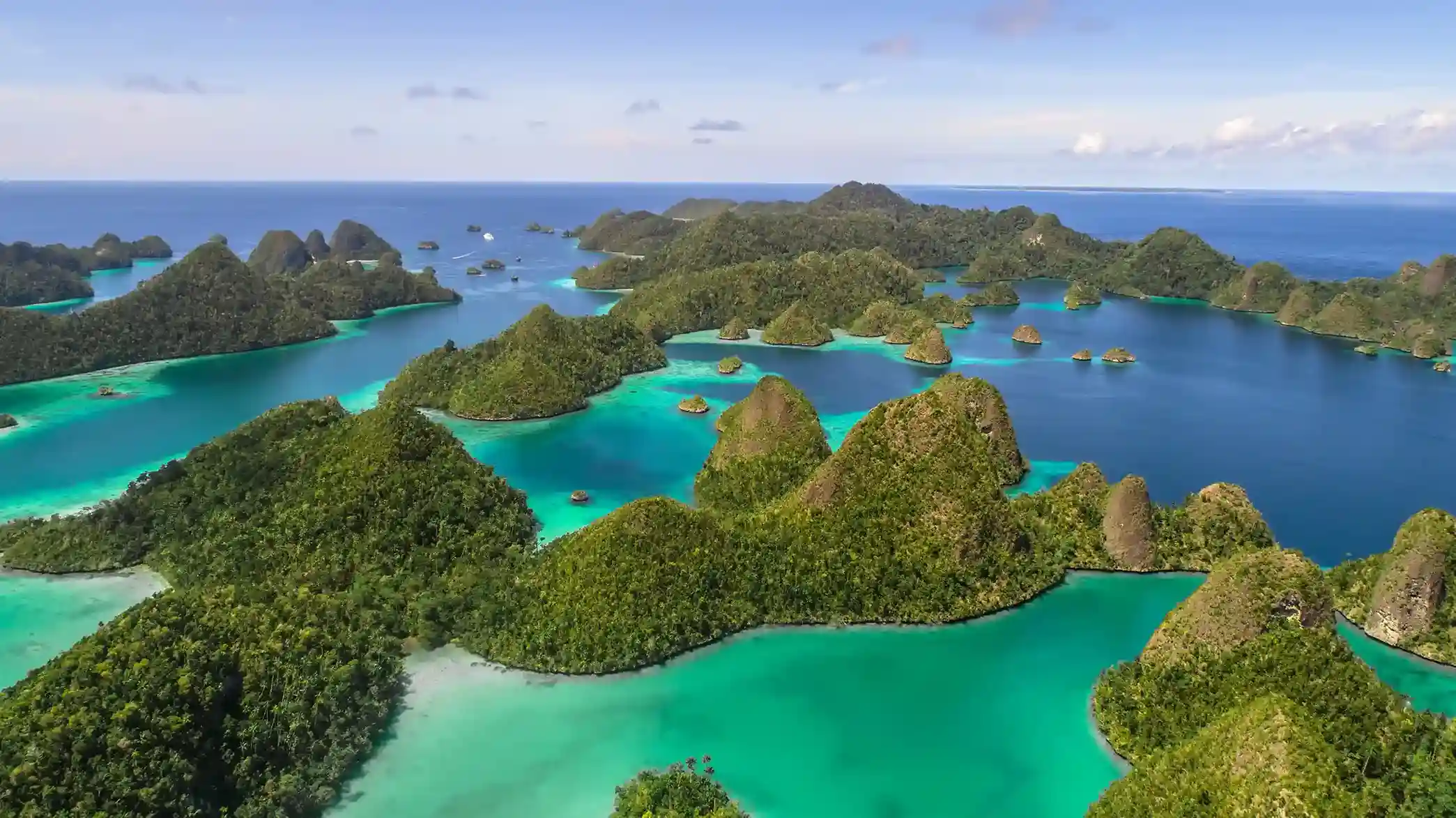
From roughly October to April, LASHA repositions from Komodo to eastern Indonesia, following the fleet-wide pattern liveaboard operators use to keep guests in sheltered water. Raja Ampat, Banda Sea, Wakatobi and Maratua charters carry a five-night minimum at $750 per guest per night for leisure ($800 with diving), with whole-boat rates from $10,500.
THE EASTERN SEASON
A phinisi that stays in one place half-wastes its hull. LASHA — 52.5 metres, 466 GT, ten ensuite cabins for up to 26 guests — was built to move with the monsoons, and her calendar follows the logic the whole luxury fleet obeys: Komodo in the dry months, the far east when Komodo turns wet.
Why does LASHA leave Komodo for part of the year?
Weather, plainly. Komodo’s dry season runs roughly April to October; the wet concentrates from December or January through March, when regional operators report rough seas, strong winds and the year’s fewest departures. Over the same months the northwest monsoon leaves Raja Ampat comparatively sheltered — which is why, as charter platforms such as Ultimate Bali and Komodo Island Tour document, most luxury phinisi base in Komodo April–October and reposition to Raja Ampat from about October or November through April. LASHA sails the same tide: her Komodo season from Labuan Bajo, then east for the expedition months.


What does a Raja Ampat expedition on LASHA look like?
Expeditions in the eastern band run a minimum of five nights — these are remote waters, and the distances only make sense with time. The format is the same private full-boat standard as Komodo: your group, all four decks, the dive deck staged for the day’s sites, dinner alternating between the Lounge & Resto and the upper-deck alfresco table. Rates hold to LASHA’s published structure rather than quote-only pricing.
The texture of the days changes, though. Komodo is a park with famous stops; the east is a wilderness with anchorages. Mornings begin with the tender nosing between karst islets, middays are for reef passes and lagoon swims, and the afternoons stretch because there is no marina to return to — the ship is the destination and the base at once. LASHA’s long-range fit-out matters here: 12,000 litres of fuel, 22,000 litres of fresh water, twin generators, and a bridge running Garmin GPS with Samyung AIS for passages far from any harbour. Five nights is the stated minimum; most groups who make the crossing take seven or more, because the flying time to reach eastern Indonesia argues against hurrying home.
Ultra-tier competitors in these waters typically price on request only. LASHA publishes her numbers on the rates page instead — the table below is the whole story, and the quote you receive will match it.
| Program | Rate per guest/night | Whole boat, 1–14 guests | Whole boat, 22 guests | Minimum |
|---|---|---|---|---|
| Raja Ampat | Banda Sea | Wakatobi | Maratua — leisure | $750 | $10,500 per night | $16,500 per night | 5 nights, 14 guests |
| Raja Ampat | Banda Sea | Wakatobi | Maratua — dive | $800 | $11,200 per night | $17,600 per night | 5 nights, 14 guests |
Marine-park entrance fees in the eastern band are $25 per guest per night, charged separately. From guest 15, each additional guest adds $750 (leisure) or $800 (dive) per night up to 22, and the free-of-charge scale applies — one FOC guest at 15 paying, up to four at 21–22. Full details on the rates page.
When do the Banda Sea crossings run?
The Banda Sea is not a detour; it is the road east. Operator consensus places the crossings in the inter-monsoon shoulder windows — September to November, which is also prime hammerhead season, and again in March–April — run as transitional expeditions between Komodo and Raja Ampat. These are the connoisseur departures: long blue-water legs, seamounts, and cabins that matter because you live in them. The two Master Suites, with in-suite jacuzzi bathtubs set against ocean-view windows, were drawn for exactly these passages.
Wakatobi, Maratua, Alor — the wider map
Wakatobi and Maratua sit inside the same five-night eastern program at $750–$800 per guest per night: atoll walls, lagoon anchorages, reef systems that reward a ship carrying its own dive deck. Alor works differently — it belongs to LASHA’s Komodo-band program (Komodo | Alor | Sumbawa | Lombok | Bali, minimum two nights at $700–$750), making it a natural rung between the two seasons. Divers weighing the eastern sites against Komodo’s should read diving from LASHA; the seasonal split decides more than the destination does.
Think of the wider map as one arc rather than four destinations. A group with two weeks and appetite can board along a repositioning leg, cross the Banda Sea in the hammerhead window, and finish among the Raja Ampat karsts — a route no fixed-base operation can sell, because it only exists for a ship in motion. Groups with less time pick a single chapter of that arc and fly to meet it.
How does the 2026–2027 eastern calendar shape up?
Work backwards from the monsoon. LASHA’s maiden Komodo season opens 17 August 2026 and runs the dry months from Labuan Bajo; her first eastern repositioning follows in the October–November 2026 window, putting her in Raja Ampat for the 2026–27 sheltered season — the first opportunity anywhere to run these waters aboard her. The March–April 2027 shoulder brings the return crossing, with Banda Sea expedition legs available in both directions, and then the cycle repeats: Komodo April–October 2027, east again from late 2027.
Booking behaviour compresses these windows more than weather does. Liveaboard operators report peak Komodo departures selling 6–12 months ahead, and the same forward pressure applies to the small number of eastern expedition slots a single ship can sail in one season — five-night minimums mean LASHA runs far fewer eastern charters than Komodo ones. If a specific school-holiday or festive window matters to your group, say so in the first message; flexible-date groups get the honest advice about which fortnight the sea favours. Route shapes and daily rhythm are described on the itineraries page.
The relocation fee, stated plainly
Honesty first: LASHA’s home port is Labuan Bajo. When your charter boards in Bali, Lombok, Sumbawa or Alor outside the scheduled positioning windows, a relocation fee applies — the ship has to sail empty to reach you, and that cost is real. The straightforward save is timing: board along a scheduled repositioning leg and the fee falls away, which is also when the Banda crossings and one-way expedition routes come up. The charter desk publishes positioning windows season by season; ask before you fix dates, and see itineraries for how routes are drawn.
One more date worth knowing: LASHA’s maiden Komodo season opens 17 August 2026, so her first eastern repositioning follows in the October–November 2026 window — the first chance anywhere to run Raja Ampat aboard her. First-season expedition slots will be few; groups who want one should open the conversation early rather than wait for a published schedule.
Plan your LASHA charter — tell us your month and we will tell you honestly where the ship should be, and what the crossing costs.
Bookings for LASHA Phinisi Cruise are handled end-to-end by Komodo Luxury, the vessel’s official marketing partner.