
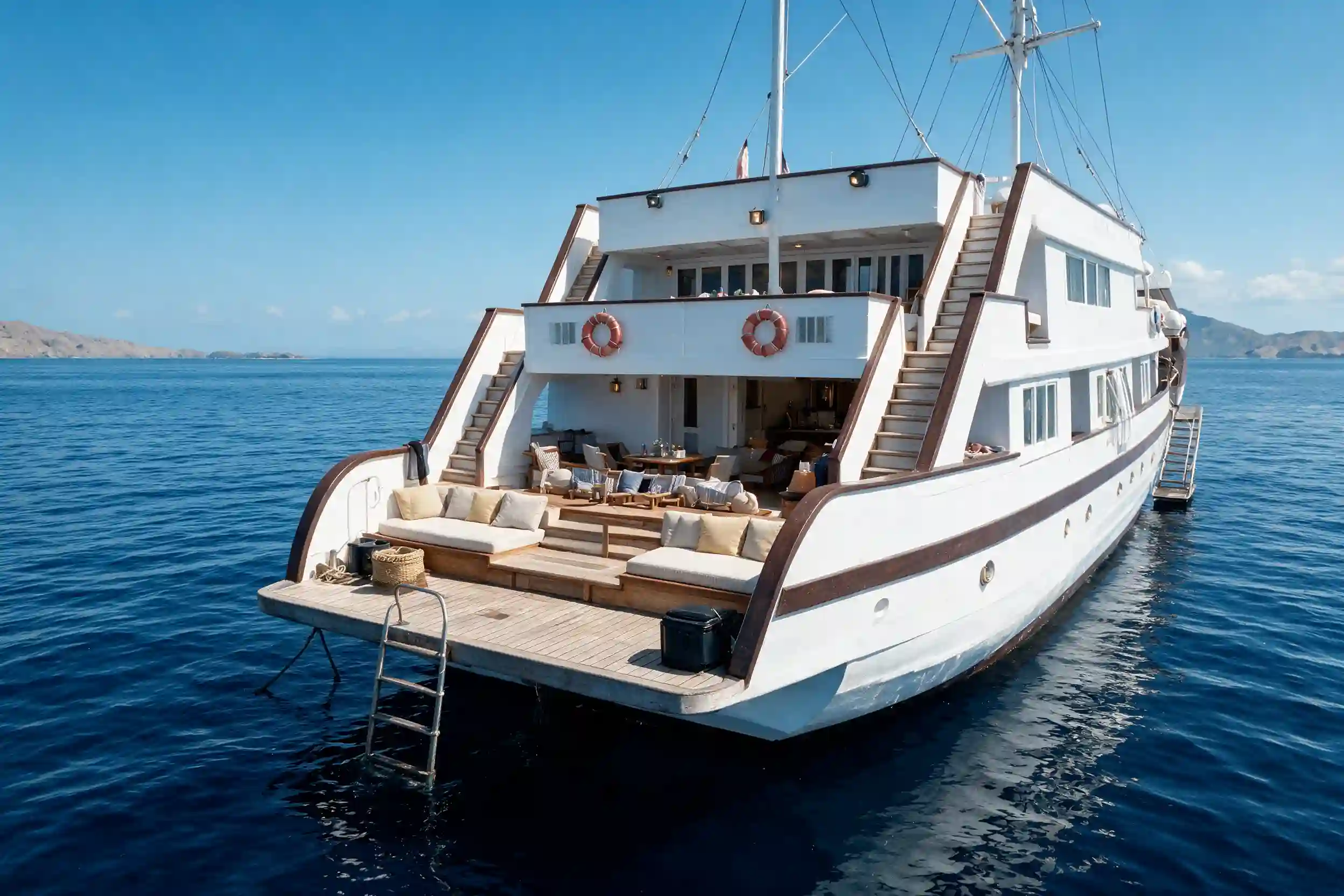
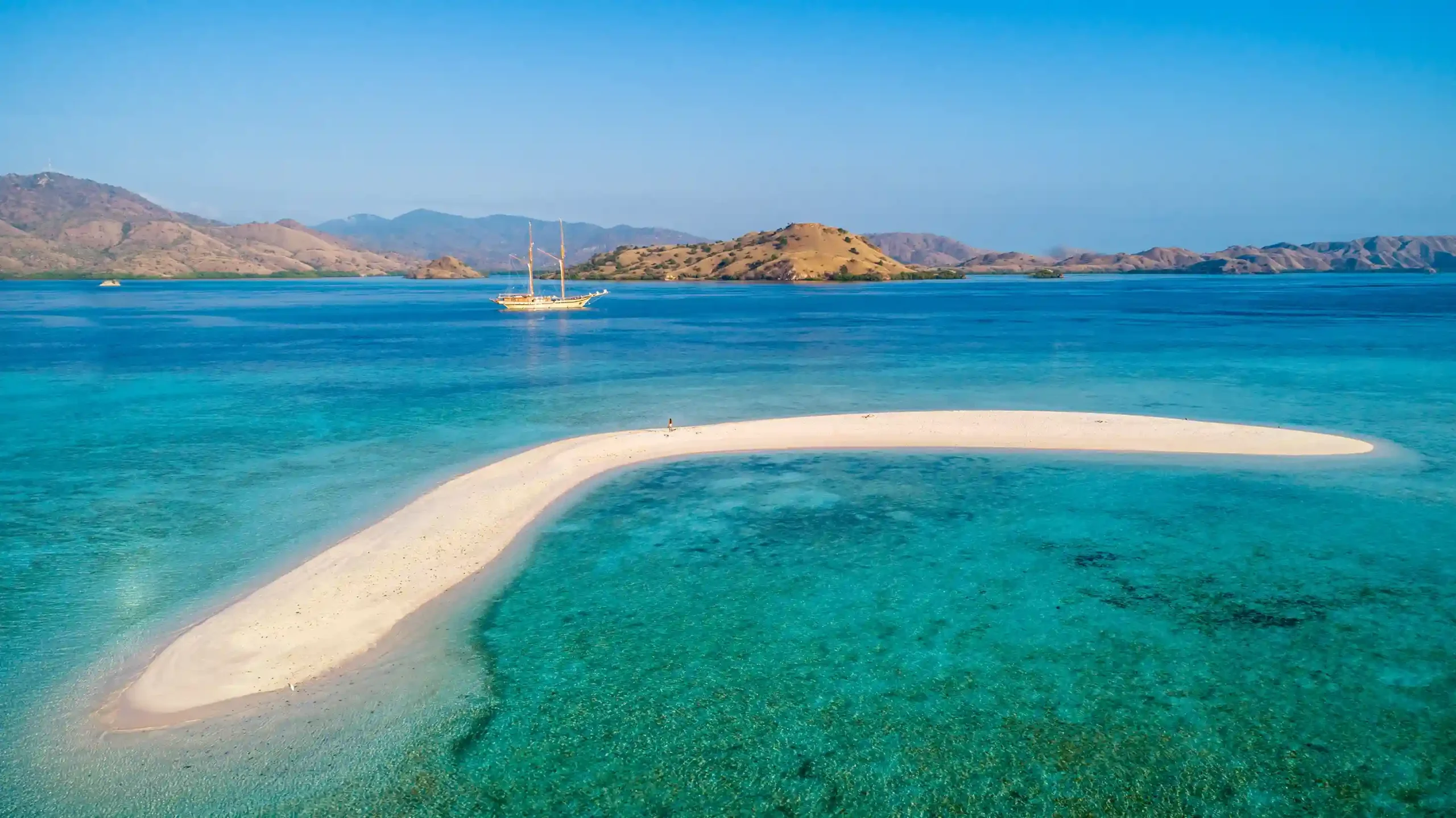
LASHA sails three signature Komodo routes from Labuan Bajo: a one-day charter (maximum 16 hours) looping Padar, Pink Beach and Komodo Island; a flagship 2D1N with sunset at Kalong and a dawn dragon trek; and a 3D2N covering Manta Point, Rinca and the park’s quieter reaches. Every itinerary flexes with tides, weather and park regulations.
ROUTES, DRAWN TO YOUR CLOCK
An itinerary on a private charter is a framework, not a script. Komodo National Park — UNESCO-listed since 1991, three main islands and a marine area of some 159,172 hectares according to the official World Heritage datasheet — rewards a captain who reads the tide tables and moves the schedule around them. The routes below are the shapes most LASHA charters take from her maiden season, which opens 17 August 2026. Your group’s version is drawn with the charter desk before departure and refined on board each evening.
How is a day aboard LASHA structured?
The rhythm is early and unhurried at once. Coffee appears on the sun deck before first light, because the park’s best hours — Padar before the heat, dragons while they are active, mantas on the moving tide — all favour early starts. Breakfast follows the morning trek or swim; lunch is long and alfresco at the upper-deck table while the ship repositions; the late afternoon belongs to the open-air jacuzzi and loungers as the light turns gold. Dinner alternates between the indoor Lounge & Resto and the alfresco table, and the living room’s smart TV and PlayStation 5 absorb whoever is not on deck counting stars.

Meals track the route, not the clock. An 05:00 Padar start means coffee and fruit before the climb and the full breakfast after it; a midday crossing means the long lunch happens under way with the islands sliding past; a Kalong anchorage means dinner is timed so the last course lands as the flying foxes lift off at dusk. The galley provisions in Labuan Bajo against your group’s dietary list, collected at booking, and on a private charter every service is cooked for one table — yours.

The 1-Day Charter: Padar, Pink Beach and Komodo in 16 hours
The day format is a full-throttle sampler: maximum 16 hours, $500 per guest with a 20-guest minimum ($10,000 flat for 1–20 guests, then $500 per additional guest up to 35), plus the $35 per-guest park entrance for the day. It suits event groups and large parties based in Labuan Bajo who want the park’s three headline stops in one sweep — and with capacity to 35 guests on the day format, it is the only LASHA program that exceeds her overnight complement. The sequence below is the proven shape; the captain re-orders it when tides or trek slots argue otherwise.
| Time | Anchorage / stop | What happens |
|---|---|---|
| 05:30 | Labuan Bajo | Board in the dark; coffee and pastries as the lines drop |
| 07:30 | Padar Island | Climb the ±800-step staircase to the ridge viewpoint, around 200 m up, over three differently coloured bays |
| 10:30 | Pink Beach | Swim and snorkel over sand tinted by red-shelled foraminifera; fresh juice on the beach |
| 12:30 | Under way | Long alfresco lunch on the upper deck while the ship crosses to Komodo Island |
| 14:00 | Loh Liang, Komodo Island | Ranger-led dragon trek — licensed guides are mandatory under park rules |
| 16:30 | Kalong approach | Sun-deck golden hour; at dusk the flying foxes stream off the mangroves |
| 21:00 | Labuan Bajo | Night return within the 16-hour window |
The 2D1N Flagship: one perfect loop
The 2D1N is LASHA’s signature: enough time for every headline site plus a night at anchor, at $900 per guest per night (minimum 14 guests; whole boat $12,600 per night for 1–14 guests rising to $19,800 at 22, entrance $35 per guest per night). One sunset, one sunrise, no rushing.
| Day | Morning | Afternoon | Evening |
|---|---|---|---|
| Day 1 | 08:00 boarding at Labuan Bajo; brunch under sail toward the park | Padar ridge climb in softer afternoon light, then Pink Beach swim | Anchor off Kalong: bat exodus at dusk, dinner alfresco, night jacuzzi |
| Day 2 | Dawn dragon trek at Loh Liang while the dragons are most active; big breakfast back on board | Manta Point drift snorkel — reef mantas typically at 10–20 m — then the Taka Makassar sandbar if tides allow | Golden-hour sail home; step ashore by early evening |

The 3D2N Full-Park Route: the whole park, unhurried
Three days and two nights runs on the multi-night program: $700 per guest per night leisure or $750 with diving (minimum two nights, minimum 14 guests; whole boat from $9,800 leisure per night; entrance $25 per guest per night). This is the format where Komodo stops being a checklist. Rinca joins the route, snorkel stops multiply, and there is time to simply be at anchor.
| Day | Route | Highlights |
|---|---|---|
| Day 1 | Labuan Bajo → Rinca → Kalong | Boarding at 09:00; afternoon ranger trek at Loh Buaya on Rinca — wild dragons live on Rinca, Komodo, Gili Motang and Nusa Kode; sunset anchorage at Kalong |
| Day 2 | Padar → Pink Beach → Komodo Island | Sunrise from the ±800-step Padar viewpoint; Pink Beach snorkel; afternoon dragon trek at Loh Liang; overnight in a sheltered bay off Komodo |
| Day 3 | Manta Point → Taka Makassar → Labuan Bajo | Morning manta drift on the tide; sandbar swim; long lunch on the sail home, arriving with the late light |
From October–November through February–March, dive-operator seasonal guidance favours the park’s southern sites around Nusa Kode, and the 3D2N pivots south accordingly. All rates above are summarised from the full tables on the 2026–2027 rates page.
Which anchorages define a LASHA route?
Four names come up on almost every charter. Kalong is the sunset anchorage — a mangrove islet whose flying foxes stream out at dusk in ribbons that last twenty minutes, best watched from the alfresco table with dinner already served. Padar’s bay is the overnight position for sunrise climbers: wake at 04:45, tender ashore in the dark, top the ±800 steps as the light arrives over the three bays. Pink Beach is the swim anchorage, close enough to reach from the stern, its sand coloured by red-shelled foraminifera mixed through white coral fragments. And Taka Makassar is the tide-dependent one — a crescent sandbar that surfaces at lower water, a short run from Manta Point, which is exactly why the captain pairs them.
Between them sit the sheltered bays off Komodo and Rinca where the ship rides quiet nights at anchor. Which bay on which night is the captain’s call, made against the wind forecast — one more decision a private charter simply absorbs without anyone noticing.
When should you schedule which route?
Match the format to the calendar. The 1-Day loop works year-round because it stays central, where operator seasonal guides say the sites hold in every month. The 2D1N is at its best in the April–October dry season — and in the June–September window of calm seas and peak 30–40 m visibility it is close to guaranteed postcard weather, which is also why those departures sell 6–12 months out across the luxury fleet. The 3D2N is the all-season shape: in the dry months it runs the classic northern loop, and from roughly October–November to March it pivots to the southern sites around Nusa Kode, trading a little rain for the December–March manta peak and empty anchorages.
Groups wanting longer than three days move onto the same multi-night program toward Alor, Sumbawa, Lombok or Bali — identical $700–$750 nightly rate, minimum two nights — or, from October to April, east to the five-night expedition band covered on the Raja Ampat page.
Why do itineraries flex — and why is that good?
Three forces move the plan. Tides first: Manta Point works on moving water, and the sandbars only show at certain heights, so the captain sequences stops around the tide tables, not the clock. Park regulations second: ranger-led treks are mandatory on Komodo and Rinca, and trek slots are coordinated with the ranger stations. Season third: central dive and snorkel sites work year-round, the north is best from about March–April to October–November, and the south takes over in the wet months — the same operator guidance that shapes LASHA’s dive charters.
And then there is the light. Every route above ends its afternoons the same way, by design: the captain positions LASHA west-facing, the jacuzzi fills, and the hour before sunset happens on the sun deck with the islands going amber around you. Golden hour is the one fixed appointment in an otherwise flexible schedule — treks move, snorkel stops swap, but no LASHA itinerary trades away that hour.
Komodo’s dry season runs roughly April to October, with June–September bringing the calmest seas and 30–40 m underwater visibility. A rigid schedule fights those facts; a private one uses them. That is the real argument for taking the whole ship, laid out in full on the Komodo charter page — and every number quoted above sits in one table on the rates page, alongside the free-of-charge scale that gives large groups up to four FOC guests.
Plan your LASHA charter — send your dates and wish-list stops, and the charter desk will draft a day-by-day route around the tides for your group.
Bookings for LASHA Phinisi Cruise are handled end-to-end by Komodo Luxury, the vessel’s official marketing partner. From October to April the ship repositions east — see Raja Ampat & beyond for five-night expedition routes.