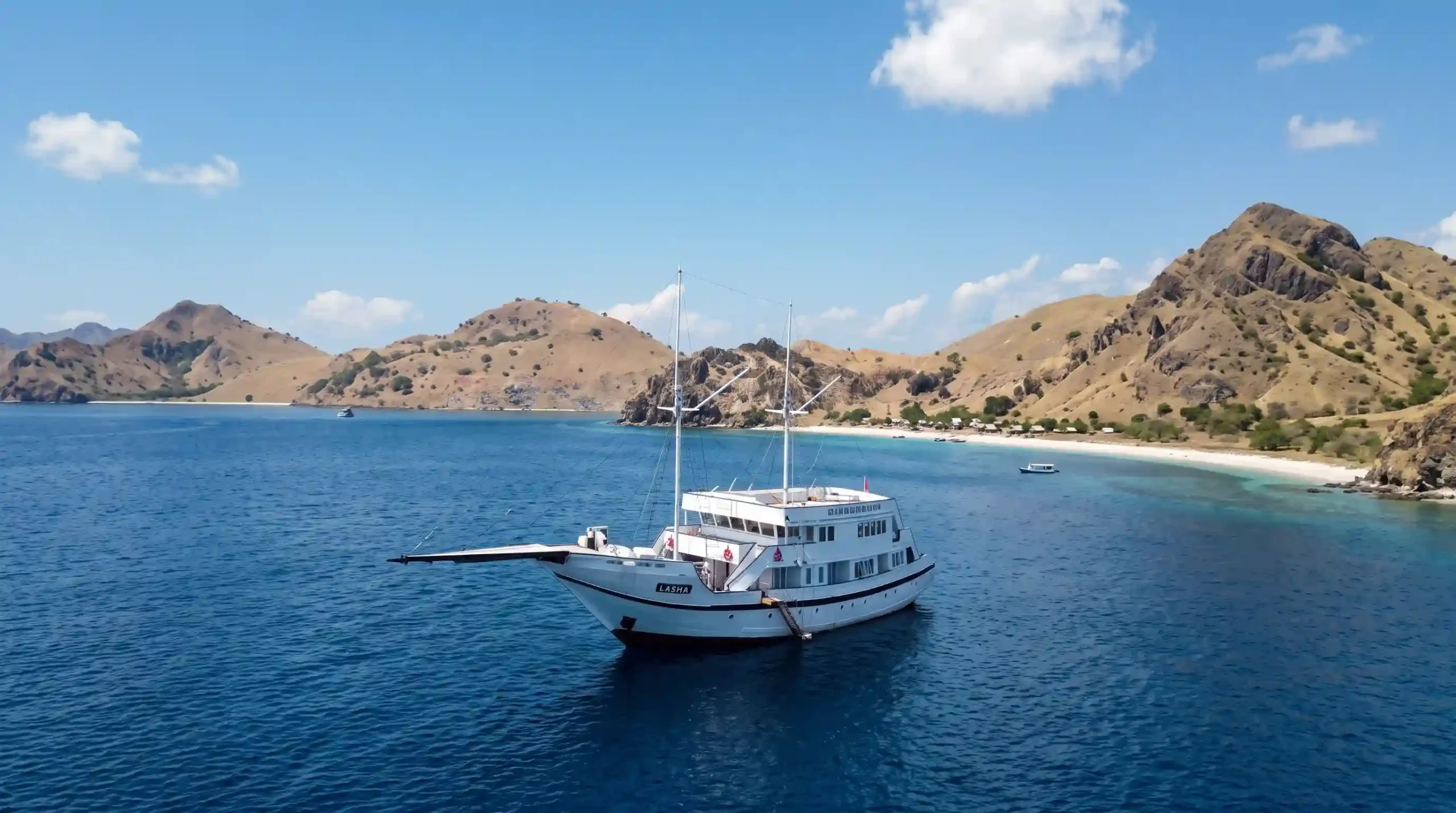

Inside the correct season it is usually fine; outside it, nobody should be out there. The Banda Sea has two workable windows — March to April and September to November — and LASHA only crosses within them. A 52.5-metre, 466 GT hull is far steadier than a small boat, but no wooden phinisi is a stabilised motor yacht. Expect three to four daylight passage days on a full crossing, and medicate before departure.
Nobody selling a cruise wants to write this page, which is precisely why it is worth reading. Motion sickness ruins trips, and it ruins them most for people who were told it would be fine and then discovered otherwise 200 nautical miles from land. Here is the honest picture: what the sea does, what the boat does, what you can do, and which itinerary to book if the answer is still "I would rather not risk it".
Why the Season Matters More Than Anything Else
The Banda Sea is not uniformly rough or uniformly calm — it has monsoon-driven periods that are workable and periods that are not. The workable windows are the westerly transition in March and April, and the easterly period from September to November. Operators avoid December to March and the strong stretch of June to September, and that avoidance is not commercial caution — it is the reason the crossing is only sold twice a year. If someone offers you a Banda crossing in January, that is the question to ask them.
| Factor | Better | Worse |
|---|---|---|
| Season | March–April, September–November windows | December–March; the strong part of June–September |
| Vessel size | 52.5 m LOA, 10.3 m beam, 466 GT | Small open-trip boats under 30 m |
| Cabin position | Low deck, amidships | High deck, forward |
| Timing of medication | Taken before departure | Taken after symptoms begin |
| Where you sit | On deck, horizon in view, air moving | Below deck, screen in front of you |
| Itinerary type | Archipelago sailings with overnight repositioning | Full crossings with daylight passage days |
Practical crew experience rather than clinical advice. Which medication suits you is a question for a doctor or pharmacist.
How Much of the Trip Is Actually Open Water?
Less than people fear, and it depends entirely on the itinerary. Sailings that stay inside Raja Ampat move between anchorages overnight, so there are effectively no daylight passage days at all — you wake up somewhere new. A full crossing between Labuan Bajo and Sorong covers 800 to 1,000 nautical miles at a planning speed of eight to ten knots, which is five to seven days of pure transit and roughly three to four full daylight sea days inside a ten to fourteen day itinerary. Those are the days in question. The rest of the trip is at anchor.
What Helps, Practically
- Medicate before departure. Every crew member and every doctor agrees on this one; nothing works well once you are already unwell.
- Stay on deck with the horizon in view. Below deck with a phone is the worst possible combination.
- Eat and drink normally. Empty and dehydrated is worse, not better.
- Ask for a low, midship cabin at booking. The difference is real and it is free.
- Sleep through it where you can. Passages often run overnight for exactly this reason.
What If You Would Rather Not Risk It at All?
Then book an itinerary that does not include a crossing. Northern Raja Ampat sailings ex-Sorong stay inside the archipelago, with short overnight repositions and no open-water days, and they reach genuinely world-class diving in the Dampier Strait. You give up the Banda Sea and its volcanoes — which are covered honestly, including the seasonal odds on hammerheads, on the Banda Sea crossing page — and you keep everything else.
We take the same position on the long southern route: our page on sailing from Bali to Raja Ampat concludes that almost everyone should fly, which is not a sentence a charter company writes lightly. For what a passage day is like when it is going well, see a full day at sea.
Frequently Asked Questions
How rough is the Banda Sea crossing?
Inside the two proper windows — March to April and September to November — it is normally comfortable. Outside them it is not a comfort question but a judgement one, and we do not sail it. That seasonal discipline is the single biggest factor in how the crossing feels.
Does a bigger boat help with seasickness?
Yes, materially. At 52.5 metres with a 10.3-metre beam and 466 GT, LASHA is a far steadier platform than the small boats that work day trips. But she is a wooden phinisi, not a stabilised motor yacht, and we will not claim she does not move.
Where is the best cabin if I am prone to seasickness?
Low and amidships, where pitch and roll are least. Ask for that when you book rather than after boarding — cabin allocation across four decks is easier to arrange in advance.
When should I take medication?
Before the passage starts, not once symptoms appear — that is the single most consistent piece of advice from crew and doctors alike. Which medication suits you is a question for your doctor or pharmacist, not for a charter company.
How many days will actually be rough?
On archipelago sailings, generally none — passages run overnight between anchorages. On a full crossing, three to four daylight passage days across 800 to 1,000 nautical miles, and not all of those will be uncomfortable.
Can I avoid open water entirely?
Yes. Northern Raja Ampat itineraries ex-Sorong stay inside the archipelago and involve essentially no open-water days. If motion is a real concern, that is the route to book.
Where These Numbers Come From
Vessel dimensions, tank capacities, cabin counts and safety inventory come from LASHA's own published specification sheet on the yacht page. Charter figures are the published 2026–2027 rate file on the rates page — the same document the Komodo Luxury charter desk quotes from, reproduced in full rather than hidden behind an enquiry form. Government fees are cited to their regulation or issuing body in the text. Anything that is an operational estimate rather than a published figure is labelled as an estimate where it appears. LASHA begins her maiden public season on 17 August 2026, so there are no guest reviews to quote yet and none are invented here. Nothing on this page is medical advice. Seasickness management is described from crew practice; medication choice is explicitly referred to a doctor or pharmacist. Figures checked 1 August 2026.
Plan This With the Charter Desk
If motion is a genuine concern, say so when you enquire — the route can be built to avoid open water almost entirely. Every LASHA Phinisi Cruise booking is handled by Komodo Luxury, the vessel's official marketing and booking partner — an operator working Indonesian waters since 2015 and part of Juara Holding Group. Send your month, guest count and how many of the party dive, and you get a written quotation drawn from the same rate bands published on this site, with every separately billed item listed before anything is paid.
WhatsApp +62 811 3823 875 [email protected]
⚓ This guide is part of the journal of LASHA Cruise — official site — the 52.5-metre luxury phinisi sailing Komodo National Park and Raja Ampat. Official booking only via lashacruise.com · WhatsApp +62 811-3823-875 (Komodo Luxury).