

A birds of paradise tour in Raja Ampat is a pre-dawn tender excursion, usually from an anchorage near Gam Island: a short forest trek, sometimes muddy, to an observation shelter, then one to two hours watching red or Wilson's birds-of-paradise display. Aboard LASHA, ask at booking to have it added to a 2027 expedition itinerary.
Most guests choose a Raja Ampat liveaboard for what lies below the waterline. The archipelago's forests, however, stage a performance found nowhere else on earth: the dawn courtship displays of the birds-of-paradise. Two of the family's most celebrated species live only in this corner of West Papua, and watching them requires nothing more than an early alarm, a tender ride in the dark, and a short walk into the hills of Gam or Waigeo. It remains one of the least-publicised excursions in the region, rarely written into standard cruise programmes, and one of the most memorable mornings a private liveaboard charter can deliver. Here is how the excursion works aboard LASHA, and how to make certain it appears in your 2027 itinerary.
How does the pre-dawn excursion work, hour by hour?
Everything depends on positioning. The evening before, LASHA anchors close to the trailhead, most often in the sheltered water off Gam Island, so the tender run is measured in minutes rather than an hour of open water in the dark. The schedule below is typical; exact timings shift with the site and the season.
| Time (typical) | What happens |
|---|---|
| 04:15 | Wake call; coffee and a light bite before departure |
| 04:45 | Tender leaves the anchorage in darkness |
| 05:00 | Landing at the village jetty; meet the local guide who manages the lek |
| 05:05–05:40 | Forest trek to the observation shelter: 20–40 minutes, occasionally muddy after rain |
| 05:40–07:00 | Displays at first light; one to two hours at the hide |
| 07:30 | Tender back to LASHA; full breakfast served on board |
The whole outing takes roughly three hours door to door. Villages on Gam manage the best-known display trees, and access runs through their own guides; LASHA's cruise director arranges this ahead of arrival, along with the community fees that keep these forests standing.
Which birds-of-paradise will you be watching?
Red bird-of-paradise (Paradisaea rubra)
Endemic to Waigeo, Gam and Batanta, the red bird-of-paradise is the species most reliably seen from the village-managed hides above Sawinggrai and Yenwaupnor on Gam. Males gather in the crowns of tall display trees, so you watch from below as they throw crimson flank plumes over their backs and trail two long, corkscrewed tail wires. On an active morning, several males compete in the same tree at once.
Wilson's bird-of-paradise (Cicinnurus respublica)
Found only on Waigeo and Batanta, Wilson's bird-of-paradise displays at ground level. The male clears a court on the forest floor, stripping away every fallen leaf so that his turquoise crown, scarlet back and coiled silver tail wires catch the low light, and viewing happens at eye level from a small blind. Wilson's sites involve a separate trek from the red bird's leks, so the two species are usually scheduled as different mornings rather than combined into one.
Are sightings guaranteed?
No, and any operator who promises otherwise is overselling. These are wild birds displaying on their own terms: heavy rain suppresses activity, a lek can go quiet without warning, and a male may perform for two minutes or for forty. What tilts the odds decisively in your favour is discipline, being seated in the hide before first light, staying silent, and using no flash, which is exactly why the excursion begins before dawn. The village guides track which display trees are active from week to week, and the crew consults them when choosing the anchorage. Most mornings reward the effort; the honest framing is high probability, not certainty.
What should you wear and bring?
- Closed walking shoes with real tread. The trails are short but can be slick and muddy after overnight rain; sandals are the most common mistake.
- Long sleeves and long trousers in quiet, dark colours.
- Insect repellent, applied before the tender leaves the ship.
- A headlamp for the walk in; it goes off at the shelter.
- Binoculars, and a long lens if you photograph. No flash at any point.
- Silence. Conversation stops at the hide; birds abandon a noisy lek.
Is the excursion included in every LASHA itinerary?
No, and this is the practical point of this article. Raja Ampat programmes are built around diving and snorkelling, and a pre-dawn land excursion only works when the previous night's anchorage sits within a short tender run of the trailhead. It is a routing decision, which means it has to be made when your itinerary is drawn up, not once you are on board. When you enquire about a 2027 Raja Ampat expedition, tell the reservations team you want the birds-of-paradise morning included; the route is then planned so that LASHA overnights off Gam at the right point in the week. The Raja Ampat season runs October to April, embarking in Sorong.
Why does it earn its place on a non-diving day?
A charter of five or more nights always contains mornings when diving is off the table: the final hours before a flight, a rest day, or simply guests in a mixed group of up to 26 across LASHA's ten ensuite cabins who do not dive at all. The birds-of-paradise excursion fills exactly that slot. It asks nothing of your no-fly window, returns you to the ship by breakfast, and leaves the afternoon free for lagoons, karst viewpoints or the house reef. Divers lose nothing: on a Raja Ampat diving charter the excursion sits neatly against off-gassing days, and on a snorkelling-led charter it simply becomes the day's first act.
What does a 2027 Raja Ampat charter aboard LASHA cost?
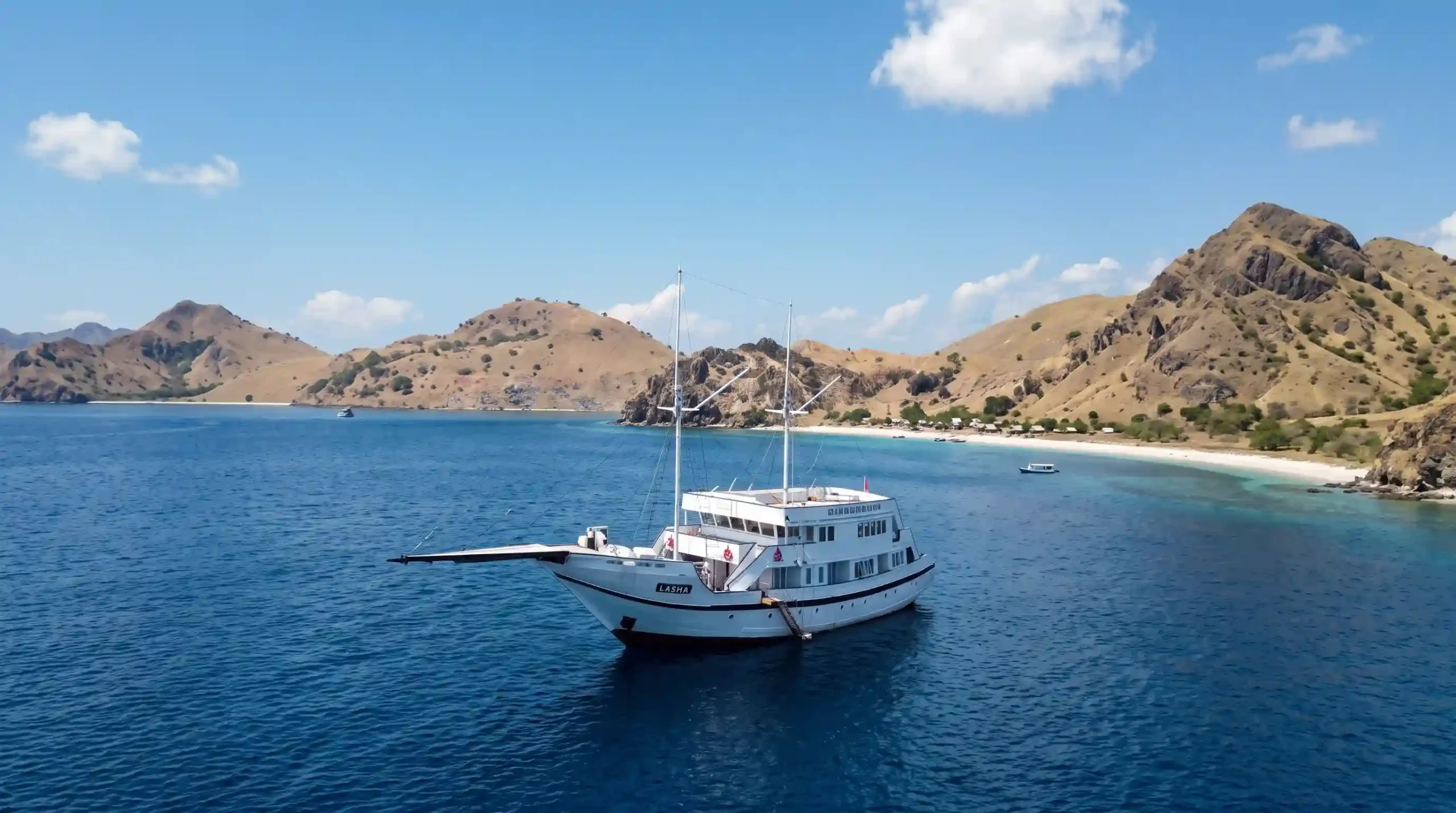
LASHA is a 52.5-metre, 466 GT phinisi built of ironwood and teak in the Buginese tradition, launched in 2023 and in service since 17 August 2026. She carries a maximum of 26 guests in ten ensuite cabins across four decks, with a dedicated dive deck and a jacuzzi on the sun deck; full deck plans are on The Yacht page. One point of candour: she is a traditional wooden phinisi without active fin stabilizers, so open-water passages are planned around conditions rather than fought through them.
| Group size (whole boat) | Leisure, per night | Diving, per night |
|---|---|---|
| 1–14 guests | US$11,600 | US$12,400 |
| 15–22 paying guests (stepped tiers) | up to US$18,200 | up to US$19,400 |
Raja Ampat charters are whole-boat with a minimum of five nights. As a working example, a seven-night leisure charter for up to 14 guests comes to US$81,200 (7 × US$11,600). Entrance fees are US$25 per guest per night, and the Raja Ampat PIN is billed separately. The stepped tiers between 15 and 22 paying guests, and the diving rate for each tier, are listed in full on the rates page. The birds-of-paradise excursion itself is arranged as part of the charter routing; what matters is requesting it early.
⚓ This guide is part of the journal of LASHA Phinisi — the 52.5-metre luxury phinisi sailing Komodo National Park and Raja Ampat. Official booking only via lashacruise.com · WhatsApp +62 811-3823-875 (Komodo Luxury).