

Most Komodo boat charters confirm with a 30–50% deposit, with the balance due 30–60 days before departure. Deposits are generally non-refundable, cancellation penalties scale as the sailing date approaches, and force-majeure events are usually resolved by rescheduling or credit rather than refund. Payment is typically made by bank transfer in USD or IDR.
Choosing the right phinisi is the enjoyable half of planning a Komodo liveaboard. The half almost nobody explains in advance is the money mechanics: how much you pay to take a vessel off the calendar, when the remainder falls due, and what happens to that money if your plans change. This guide sets out how deposits, payment schedules, and cancellation terms typically work across the Komodo private charter category — so that when you request dates aboard LASHA, nothing in the contract surprises you.
How much deposit does a Komodo boat charter require?
Across the industry, a deposit of 30–50% of the total charter price is the standard trigger for confirmation. Until it is paid, most operators will only hold dates provisionally — usually for a few days — and the calendar remains open to other inquiries. Once the deposit lands, the vessel and dates are yours.
The reason deposits are almost universally non-refundable comes down to inventory. A private charter blocks the entire vessel: one hull, one calendar. If a booking collapses eight weeks out, the operator rarely has a realistic chance of reselling those exact dates, and the crew, provisioning, and permit planning have already been committed. The deposit is what compensates that risk.
The sums involved make this worth understanding precisely. Whole-boat rates for LASHA are priced by trip length and group size for leisure charters of 1–14 guests (minimum two nights) — a five-day, four-night charter totals US$43,200 — meaning a 50% deposit is US$21,600. That is real money, which is exactly why the rest of this guide matters.
When is the balance due — and why does peak season change it?
The industry norm is balance payment 30–60 days before departure. In peak season — July and August, and the Christmas–New Year window — terms typically tighten: earlier balance deadlines and sometimes higher deposit percentages. A lost peak-season week is the costliest gap in an operator's year, so contracts protect it more aggressively.
| Milestone | Industry norm | What it covers |
|---|---|---|
| At confirmation | 30–50% deposit | Secures the vessel and dates; generally non-refundable |
| 60 days before departure | Balance due (peak season) | Full charter price settled for high-demand dates |
| 30 days before departure | Balance due (regular season) | Full charter price settled for standard dates |
| Pre-departure or on board | Park fees and extras | Komodo National Park entrance is billed at US$25 per guest per night on LASHA |
Read your contract for the exact trigger: some operators count days to embarkation, others to the first day of the month of travel. Missing a balance deadline can itself be treated as a cancellation, so diarise it the day you sign.
What does a typical cancellation penalty scale look like?
Cancellation terms in this category are tiered: the closer to departure you cancel, the larger the share of the charter price retained. The exact percentages vary between operators, but the shape is nearly universal.
| Cancellation window | Typical penalty |
|---|---|
| 90+ days before departure | Deposit retained (often convertible to a date change) |
| 89–60 days | Around 50% of the charter total |
| 59–30 days | Around 75% of the charter total |
| Under 30 days, or no-show | 100% of the charter total |
Two details deserve attention before you sign. First, whether the penalty is calculated on the full charter price or only on amounts already paid. Second, whether a reduction in guest numbers counts as a partial cancellation — on a whole-boat charter it usually does not, because you have bought the vessel, not seats.
Can you move your dates instead of cancelling?
Almost always the better route. Most operators treat a date change requested before the balance deadline far more generously than a cancellation: typically one change is permitted, subject to availability, with any seasonal rate difference paid by the guest. Credits, where offered, commonly remain valid for 12–24 months.
A date change can also become an upgrade in disguise. LASHA sails Komodo year-round from Labuan Bajo, and repositions for the Raja Ampat season from October to April — so shifting a cancelled July week to November could convert into a Raja Ampat voyage instead. Compare itineraries before deciding whether to reschedule like-for-like or change region entirely.
What happens if the port closes or force majeure strikes?
Some disruptions are outside everyone's control: harbourmaster port closures for weather, national park closures, or government directives. The industry standard for these events is a reschedule or a credit for the affected days — not a cash refund. Operators cannot insure themselves against a closed port any more than you can, so the contract shares the risk by preserving the value of your booking rather than returning it.
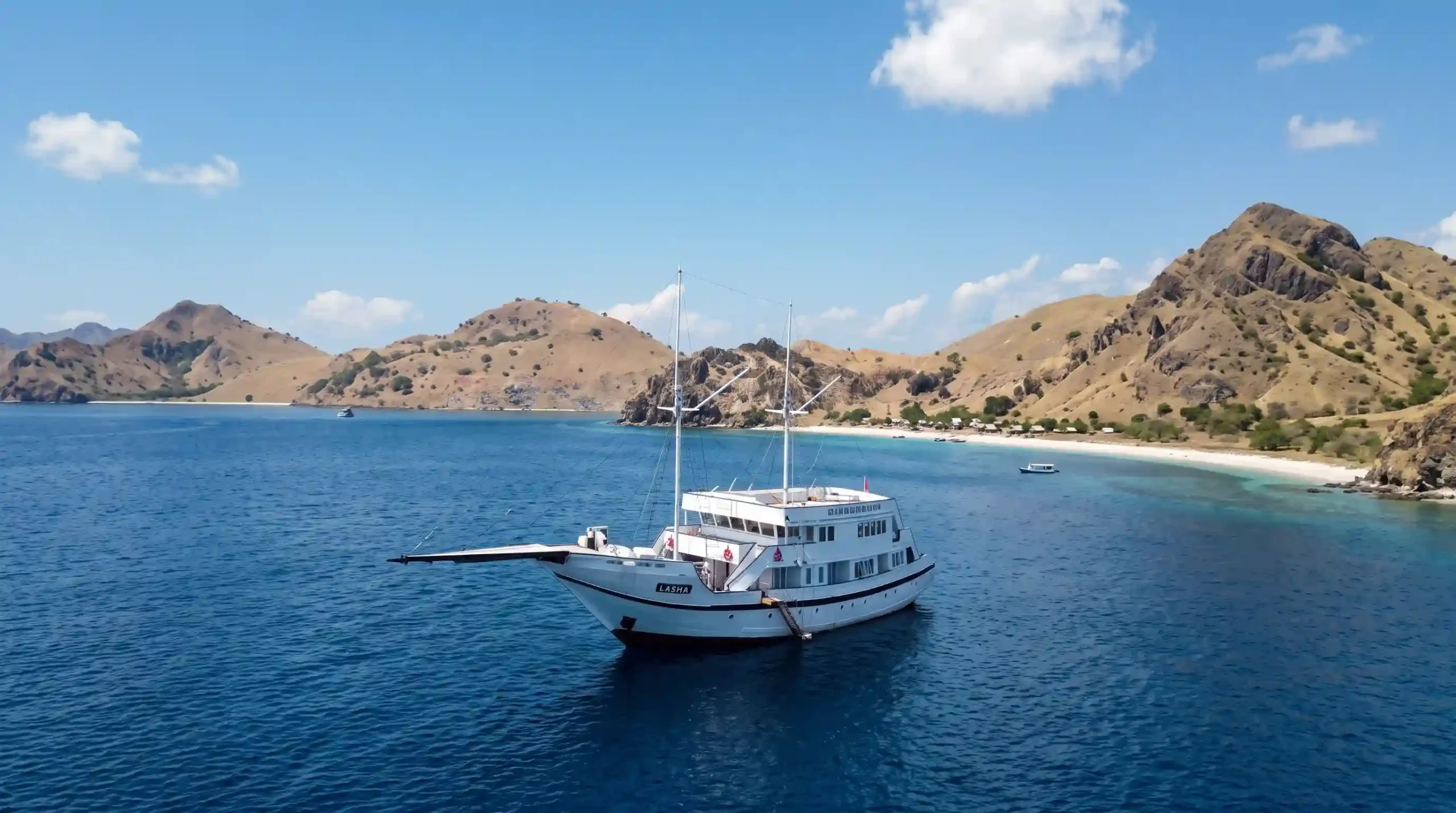
Mid-cruise weather works differently again. The captain holds final authority over routing and safety, and itineraries adjust to conditions rather than cancel. It is worth being honest about the platform here: LASHA is a traditional ironwood-and-teak phinisi of 52.5 metres — a wooden sailing vessel without active fin stabilizers — and her captains respond to rough weather the traditional way, by rerouting to sheltered anchorages rather than pushing through open swell. The same conservatism applies to departure decisions. You can read the full construction details on the yacht page.
How should you pay — bank transfer or card?
Bank transfer in USD or IDR is the default settlement method for charters at this level. It carries no surcharge, but international wires attract intermediary fees — instruct your bank to send with shared or sender-paid fees so the full contracted amount arrives, otherwise you may be asked to top up a shortfall.
Card payments, where accepted, typically carry a 2.5–3.5% processing surcharge passed on to the guest, and daily card limits often sit below whole-boat charter totals anyway. Cards earn their place mainly for smaller balances or extras.
One security note that applies to the entire category: verify account details through official channels before every transfer, and re-verify if payment instructions ever appear to change mid-correspondence. For LASHA, the only official booking channels are lashacruise.com, WhatsApp +62 811-3823-875, and [email protected].
Do you need trip-cancellation insurance?
Given that deposits are non-refundable and penalties reach 100% inside the final month, trip-cancellation insurance covering the full charter value is the rational hedge — and we recommend it plainly, even though we do not sell it. Buy the policy shortly after paying your deposit: many insurers require purchase within 14–21 days of the first trip payment to include their most valuable waivers.
Check four things in any policy: cancellation cover up to the full charter cost, travel-delay and missed-connection cover for the journey to Labuan Bajo, medical and emergency evacuation cover appropriate for a remote marine park, and — for dive charters — that scuba diving is not excluded. An independent broker can match a policy to your itinerary in an afternoon.
How does booking LASHA actually work?
The sequence is straightforward. You send an inquiry with dates, guest count, and whether the charter is leisure or diving; the reservations team confirms availability and issues a proposal with the exact payment and cancellation terms in writing. A signed agreement and deposit confirm the vessel; the balance follows on the contracted schedule; pre-cruise details — guest manifest, dietary notes, flight times — are collected in the final weeks.
The commercial outline: whole-boat leisure and diving charters, minimum two nights, priced by trip length and group size — see the rates page — with capacity up to 26 guests across ten ensuite cabins. LASHA is operated by Komodo Luxury (PT Komodo Bahari Nusantara, established 2015), sails from her home port of Labuan Bajo, and entered service with her maiden voyage on 17 August 2026. Every figure in this article describes industry norms; the terms that bind your booking are the ones in your own charter agreement, which you will see in full before any money moves — start on the booking page.
⚓ This guide is part of the journal of the LASHA Liveaboard — the 52.5-metre luxury phinisi sailing Komodo National Park and Raja Ampat. Official booking only via lashacruise.com · WhatsApp +62 811-3823-875 (Komodo Luxury).